Albuterol Inhaler Cost Without Insurance 2026: Real Prices
You hand over the prescription, the pharmacist scans it, and the number on the screen is $89. For a rescue inhaler. The same little canister your neighbor swears she got for $19.
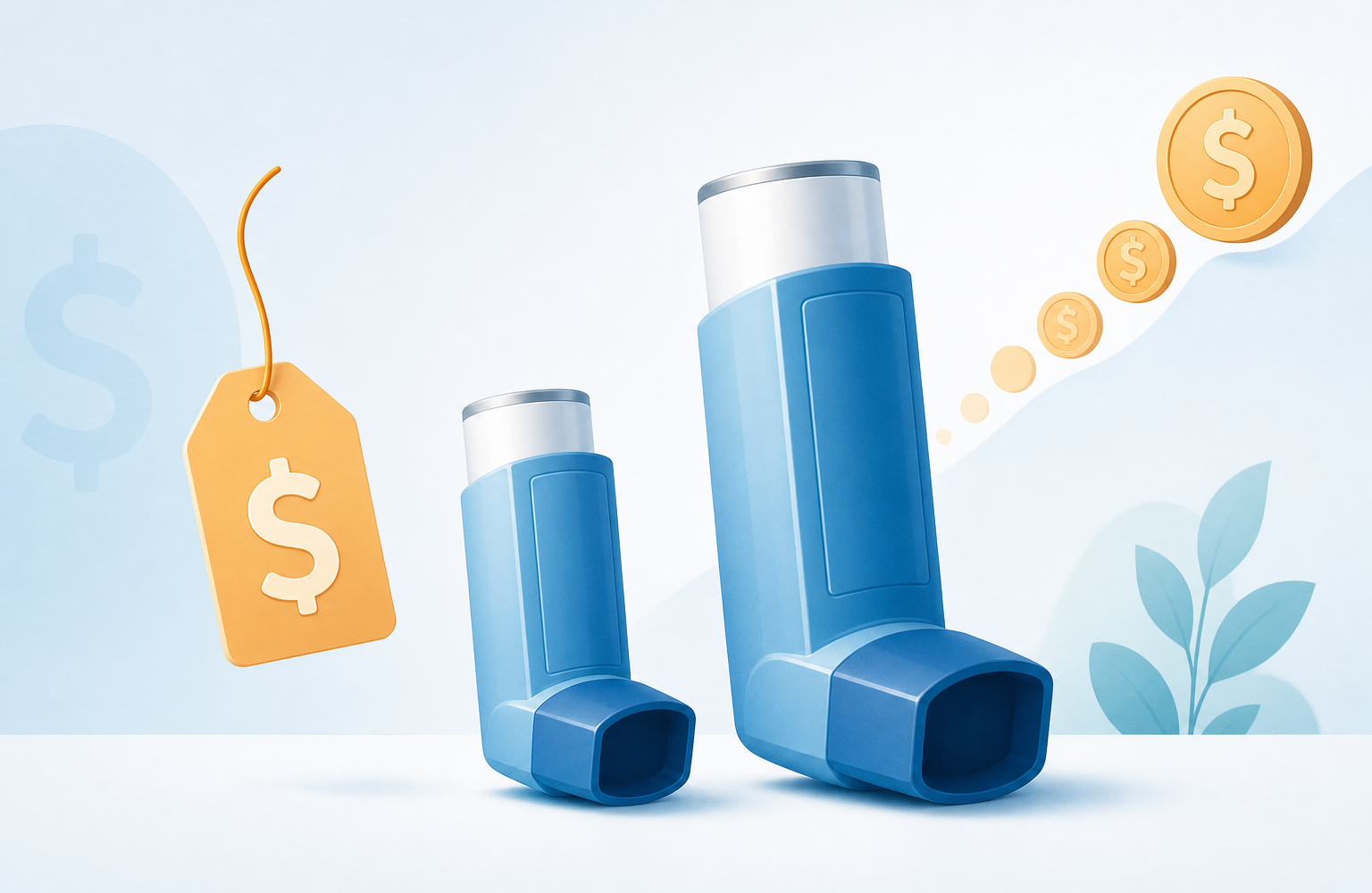
Both of you are telling the truth. Albuterol inhaler cost without insurance swings wildly — not just between pharmacies, but between canister sizes that look nearly identical sitting on the counter. Most people never find out that the inhaler they picked because it had the lowest sticker price was the most expensive one in the case.
At a glance
- Generic albuterol HFA inhalers average $33 to $42 at retail, but real cash prices run as high as $98 depending on the pharmacy
- The 8 g brand Ventolin canister costs less up front ($30) than the 18 g one ($78) — but holds only 60 puffs instead of 200
- Albuterol never got $4-generic cheap because the 2008 propellant switch reset the patents on the inhaler device itself
- Generic albuterol is covered by 97.8% of commercial plans; brand-name Ventolin, by only about 46%
- Cash-pay pricing through networks like CanAmerica Plus is worth checking before you pay retail
How much does an albuterol inhaler cost without insurance?
Average retail sits in the mid-$30s to low-$40s for a generic HFA inhaler. That's the average. The actual range at the counter is much wider, and the spread between the cheapest and most expensive pharmacy in a single zip code can be close to 2x for the identical product.
Here's what the common versions run at average retail:
| Version | Size | Actuations | Average retail |
|---|---|---|---|
| Generic ProAir HFA | 8.5 g | 200 | $33.13 |
| Generic Proventil HFA | 6.7 g | 200 | $33.77 |
| Generic Ventolin HFA | 18 g | 200 | $42.19 |
| Ventolin HFA (brand) | 8 g | 60 | $30.31 |
| Ventolin HFA (brand) | 18 g | 200 | $77.92 |
| ProAir RespiClick (brand, dry powder) | 0.65 g | 200 | $93.40 |
Prices reflect national average retail as of 2026 and change often.
Worth knowing before you shop: brand-name Proventil HFA and ProAir HFA have both been discontinued. What sits on the shelf under those names now is the generic. Ventolin HFA is the one major brand still actively marketed, which is part of why it carries the biggest premium.
The canister size trap
Look at that table again, specifically at the two brand Ventolin rows. One is $30.31. One is $77.92. A reasonable person picks the $30.31.
That person just paid more per dose than almost anyone else in the pharmacy.
The 8 g canister contains 60 actuations. The 18 g contains 200. Run the division:
| Version | Price | Actuations | Cost per puff |
|---|---|---|---|
| Generic ProAir HFA 8.5 g | $33.13 | 200 | $0.17 |
| Generic Proventil HFA 6.7 g | $33.77 | 200 | $0.17 |
| Generic Ventolin HFA 18 g | $42.19 | 200 | $0.21 |
| Ventolin HFA 18 g (brand) | $77.92 | 200 | $0.39 |
| Ventolin HFA 8 g (brand) | $30.31 | 60 | $0.51 |
The cheapest-looking inhaler on the shelf costs three times as much per dose as the generic sitting next to it.
This matters more than it sounds. A standard rescue dose is two puffs. If you use your inhaler twice a week, a 200-puff canister lasts you the better part of two years; a 60-puff canister runs out in about seven months. If you're using it daily — which is a conversation to have with your doctor, because daily rescue inhaler use usually means your asthma control needs adjusting — the 60-puff canister is gone in a month.
Savings tip: When your prescriber writes the script, ask them to specify the 200-actuation canister. Pharmacies fill what's written, and the smaller canisters are often what's in stock by default. One sentence on the prescription can cut your cost per dose by more than half.
Why generic albuterol never got as cheap as other generics
Most generics collapse to $4 or $10 once the patent expires. Albuterol didn't, and there's a specific reason.
Albuterol the molecule has been off patent for decades. But an inhaler isn't a pill — it's a drug plus a metered-dose delivery device, and the device gets its own patents. In 2008, under the Montreal Protocol, the FDA phased out CFC propellants in inhalers. Every manufacturer had to reformulate around hydrofluoroalkane, and those reformulated HFA inhalers were newly patentable products. The generic clock effectively restarted on a drug that had been generic since the 1980s.
The knock-on effect never went away. To bring a generic HFA inhaler to market, a manufacturer has to prove the device delivers an equivalent dose, not just that the chemistry matches. That's a far harder approval than copying a tablet, so only a handful of companies make generic albuterol HFA. Few manufacturers, little price competition, prices that sit at $30 to $99 instead of $4.
So when you're standing at the counter wondering why your "generic" inhaler costs more than a month of most blood pressure medication — that's why. It isn't your pharmacy gouging you.
What about the nebulizer version?
Albuterol also comes as an inhalation solution for a nebulizer, sold as salbutamol nebules and generic equivalents. It's the same drug, delivered as a mist over several minutes instead of a puff.
| Form | Quantity | Average retail |
|---|---|---|
| Inhalation solution, 1.25 mg/3 mL | 25 vials | $33.66 |
| Inhalation solution, 0.63 mg/3 mL | 25 vials | $39.46 |
| Inhalation solution, 5 mg/mL | One 20 mL bottle | $64.39 |
| Oral syrup, 2 mg/5 mL | One 120 mL bottle | $22.26 |
| Oral tablets, 4 mg | 30 tablets | $127.13 |
A 25-vial box lands in roughly the same price band as a single inhaler, which makes the nebulizer route worth pricing out if you already own a machine — or if you're dosing a young child who can't reliably coordinate an inhaler. Home nebulizer compressors are a one-time purchase, often under $40.
The oral forms are a different story. Albuterol tablets at $127 for a month are both more expensive and less effective for acute symptoms than a $33 inhaler, which is why they're rarely prescribed anymore. If someone suggests them as a budget option, they aren't one.
If you use a nebulizer regularly, our guide to DuoNeb costs and alternatives covers the combination ipratropium-albuterol option many people with COPD end up on.
Brand vs. generic: what the coverage data shows
For albuterol specifically, generic is the clear play — and insurers agree emphatically.
| Product | Commercial plans covering | ACA plans covering |
|---|---|---|
| Generic albuterol | 97.8% | 88.1% |
| Brand Ventolin HFA | 46.5% | 47.4% |
| ProAir RespiClick | 46.1% | 45.0% |
Coverage data as of the most recent national analysis.
If you're uninsured this table still tells you something useful: near-universal formulary coverage of the generic means high dispensing volume, which means every pharmacy stocks it and none of them can charge brand prices for it. The 46% coverage on brand Ventolin is why so many people end up paying full freight for it — their plan simply doesn't cover it, and they don't realize the generic is right there.
One caveat on switching: Xopenex HFA (levalbuterol) is the other short-acting rescue inhaler, sometimes suggested for people who get jittery on albuterol. It typically costs close to double. It's a legitimate clinical choice for some people, but it isn't a money-saving one.
What changes the price you pay
Pharmacy. The single biggest variable. The same NDC can differ by nearly 2x across pharmacies a few miles apart. Independent pharmacies are sometimes dramatically cheaper than chains, sometimes not — you have to call.
Canister size. Covered above. Ask for 200 actuations.
Generic vs. brand. For albuterol, generic is nearly always right.
How many you fill at once. Many people with asthma reasonably keep more than one inhaler — one at home, one in a bag or at work. Filling two or three at once often prices better per unit than three separate trips, and it means you're never rationing a nearly-empty canister.
Where you buy. Retail pharmacy cash price is the default, not the floor. Transparent-pricing pharmacies and cash-pay networks often price well below it.
How to pay less for albuterol without insurance
Before you pay retail: Check the cash price for albuterol inhalers through CanAmerica Plus alongside two or three local pharmacies. Cash-pay network pricing is one option among several, and the only way to know which wins for you is to compare the actual numbers side by side.
Call three pharmacies and ask for the cash price. Not the insurance price — the cash price. Say the exact product: "generic albuterol sulfate HFA, 200 actuations." The quotes you get back will surprise you.
Ask about the 200-actuation canister by name. It's the single most useful question in this article, and it costs you nothing to ask.
Use a spacer. A spacer (roughly $15 to $30, one-time) improves how much medication actually reaches your lungs instead of coating the back of your throat. Better delivery per puff means the canister lasts longer and works better. Pediatricians have recommended these for decades for exactly this reason.
Don't test-fire more than you need to. Priming instructions exist for a reason, but some people discharge several puffs into the air out of habit before each use. At $0.17 to $0.51 a puff, that adds up over a year.
Track your doses. Most albuterol inhalers don't have counters. People routinely discard canisters that still have medication and, worse, keep using ones that are empty and only propellant. Marking the fill date on the canister with a marker is a two-second habit that stops both.
Revisit your controller medication. If you're refilling rescue inhalers often, the expensive problem may not be the rescue inhaler. Well-controlled asthma usually means needing albuterol rarely. Controller inhalers like Symbicort Turbuhaler, Advair Diskus, Flovent HFA, and Trelegy Ellipta cost more per unit but can dramatically reduce how much rescue medication you burn through. We break the numbers down in our guides to Symbicort costs and Trelegy costs.
One safety point worth repeating
Cost-cutting has a hard floor with rescue inhalers, and it's this: never stretch an albuterol inhaler you think is empty, and never go without one because of price.
Albuterol is the medication that keeps an asthma attack from becoming an emergency. An ER visit for bronchospasm costs orders of magnitude more than the most expensive inhaler on the list above — and that's only the financial argument. If you genuinely cannot afford a refill, tell your prescriber that plainly. Practices deal with this constantly and have options, including samples and alternative products, that they won't offer unless you say something.
Also worth flagging to your doctor: needing your rescue inhaler more than twice a week is a recognized signal that your asthma isn't adequately controlled. That's a treatment conversation, not a budgeting one.
The bottom line
Generic albuterol HFA runs about $33 to $42 at average retail, though real cash prices reach $98 depending on where you fill it. The single change that saves most people the most money isn't a discount at all — it's asking for the 200-actuation canister instead of the 60, which cuts cost per dose by roughly two-thirds.
Call a few pharmacies, compare against cash-pay pricing, and put the fill date on the canister. Then talk to your prescriber about whether your controller therapy is doing its job.
Frequently asked questions
Why is my generic albuterol inhaler still expensive?
Because an inhaler is a device as well as a drug. When the FDA phased out CFC propellants in 2008, manufacturers reformulated around HFA propellants and those new inhalers carried fresh patents. Generic approval requires proving the device delivers an equivalent dose, which is much harder than copying a tablet, so only a few manufacturers make generic albuterol HFA and prices never dropped to typical generic levels.
How many puffs are in an albuterol inhaler?
Most are 200 actuations, but not all. The 8 g brand Ventolin canister holds only 60. Since the smaller canisters sometimes carry a lower sticker price, it's easy to pay more per dose without realizing it. Check the actuation count on the box, not just the price.
Is brand-name Ventolin worth the extra cost over generic?
For most people, no. Generic albuterol HFA contains the same active ingredient at the same dose and is covered by 97.8% of commercial plans, versus about 46% for brand Ventolin. Some people prefer a specific inhaler's taste or spray feel, which is a real preference — just not a clinical reason to pay double.
Can I use a nebulizer instead of an inhaler to save money?
Sometimes. A 25-vial box of albuterol inhalation solution runs about $34 to $39, comparable to a single inhaler, and home nebulizer machines are often under $40 as a one-time cost. It's most worth pricing out for young children who can't coordinate an inhaler, or if you already own a nebulizer. Ask your prescriber before switching forms.
What happened to Proventil HFA and ProAir HFA?
Both brand-name versions have been discontinued. The generic versions remain widely available and are what pharmacies dispense under those product names now — which is generally good news for your wallet, since the generics are among the cheapest albuterol options.
This article is for informational purposes only and does not constitute medical advice. Always consult with a qualified healthcare provider for diagnosis and treatment. Pricing information is current as of the publication date but may change. Verify pricing directly before making purchasing decisions.