Dental Implant Cost Without Insurance 2026: Real Prices
You go in to ask about one missing molar and leave holding a treatment plan for $5,400. Then the practice across town quotes $3,100 for what sounds like the same thing. Neither office is lying to you.
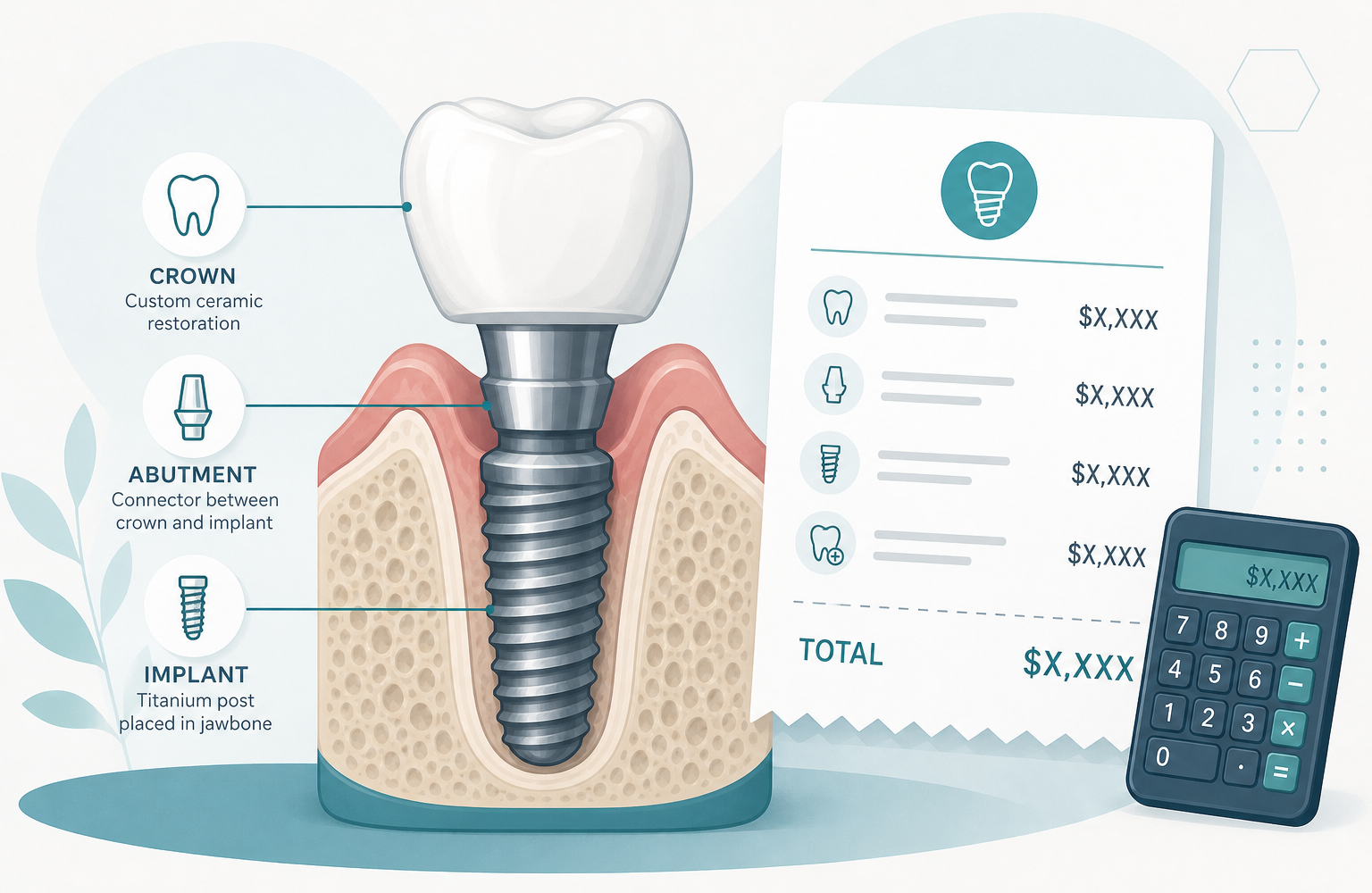
The gap is almost never the implant itself. It's the bone graft, the abutment style, the crown material, and a handful of line items that appear on one plan and not the other — and none of it is visible from the total at the bottom of the page.
At a glance
- A single tooth implant, start to finish, runs $3,000–$6,000 without insurance in 2026 — post, abutment, and crown together.
- The titanium post alone is only about half of that; the crown and abutment are the rest.
- Bone grafting adds $400–$1,200, and a sinus lift adds $1,500–$3,000 — this is where two quotes diverge most.
- A full arch on four implants runs $15,000–$30,000 per arch; a two-implant overdenture runs $6,000–$12,000.
- Dental school clinics commonly place a single implant for $1,500–$3,000 all in, and there are roughly 70 of them in the US.
- Most dental plans cap out at $1,000–$2,000 a year anyway, so having insurance changes this bill less than people expect.
How much does a dental implant cost without insurance?
The published ranges look inconsistent until you notice they're counting different things.
Delta Dental puts a single implant without dental benefits at $2,800–$5,600. GoodRx says $3,000–$7,000 for one tooth including the post, abutment, and crown. CareCredit reports a national average of $2,143 with a range of $1,646–$4,175. Aspen Dental publishes implant denture pricing from $6,102 to $10,638 for two implants. Smart Arches, a specialist implant group, prices single implants from $4,499.
CareCredit's $2,143 is the outlier, and it's worth understanding why: averages built from claims data get pulled down by cases where the graft and the crown were billed separately or in a different calendar year. The number most people actually write checks against is $3,000 to $6,000 for one finished tooth.
Here's what that money buys, with the dental codes that will appear on your treatment plan:
| Line item | CDT code | Typical self-pay |
|---|---|---|
| Implant body (the titanium post) | D6010 | $1,600 – $2,500 |
| Second-stage surgery to uncover the implant | D6011 | $200 – $600 |
| Prefabricated abutment | D6056 | $300 – $650 |
| Custom-milled abutment | D6057 | $400 – $900 |
| Implant crown, porcelain fused to metal | D6059 | $1,000 – $1,800 |
| Implant crown, all-ceramic or zirconia | D6065 | $1,200 – $2,500 |
| CBCT scan (3D imaging) | D0367 | $150 – $500 |
| Surgical guide | D6190 | $200 – $500 |
| Temporary crown during healing | D6085 | $300 – $800 |
Ask the front desk to print the plan with those codes on it. It takes about a minute, and it's the only way to compare two quotes honestly. A $3,100 plan with a prefabricated abutment and a metal-backed crown and a $5,400 plan with a custom abutment and a zirconia crown are not the same purchase — but you can't tell that from the totals.
Where the quotes really diverge: bone
Most people focus on the implant. The variable that actually swings the number is whether your jaw has enough bone to hold one.
Bone starts resorbing the moment a tooth comes out, and it goes fast — the sharpest loss happens in the first six months. If the tooth has been gone two years, there's a reasonable chance you need bone built back before an implant will hold.
| Procedure | CDT code | Typical self-pay | When it's needed |
|---|---|---|---|
| Socket preservation at extraction | D7953 | $250 – $1,200 | Tooth is being pulled now, implant planned later |
| Bone graft at implant placement | D6104 | $400 – $1,200 | Minor deficiency, grafted the same day |
| Ridge augmentation, separate surgery | D7950 | $1,200 – $3,000 | Substantial bone loss, needs months to heal first |
| Sinus lift, lateral window | D7951 | $1,500 – $3,000 | Upper back teeth, sinus floor too low |
| Sinus lift, through the socket | D7952 | $600 – $1,500 | Smaller lift, done at placement |
An upper molar that needs a lateral sinus lift can take a $4,000 case to $7,000 without anyone padding the bill. That's the single most common reason two quotes for "an implant" differ by thousands.
If you're having the tooth pulled soon and think you might want an implant later, socket preservation at the time of extraction is the cheapest bone you will ever buy. Rebuilding a collapsed ridge two years later costs several times more. Our guide to tooth extraction cost without insurance covers when that graft is worth paying for and when it isn't.
Molars cost more than front teeth
Same as with extractions, position drives price. Back teeth take more force, need wider implants, and sit closer to the sinus above and the nerve canal below.
| Position | What complicates it | Typical all-in self-pay |
|---|---|---|
| Front tooth (incisor or canine) | Cosmetics — gum contour and shade matching | $3,000 – $6,500 |
| Premolar | Usually the most straightforward site | $2,800 – $5,000 |
| Lower molar | Nerve proximity, wider implant | $3,200 – $6,000 |
| Upper molar | Sinus proximity, lift often needed | $3,500 – $8,000 |
Front teeth surprise people. The surgery is often simpler, but a visible tooth has to match its neighbors in shade, translucency, and gum line, which usually means a custom abutment and a lab-crafted ceramic crown. You're paying for esthetics rather than bone work.
Full mouth implants: the numbers that actually apply
"Full mouth dental implants" covers three very different treatments at three very different prices, and the term gets used loosely enough that people arrive expecting the cheap version and get quoted the expensive one.
| What you're getting | Implants per arch | Typical self-pay, per arch | Both arches |
|---|---|---|---|
| Implant-retained overdenture (removable, snaps on) | 2 – 4 | $6,000 – $15,000 | $12,000 – $28,000 |
| Fixed full-arch bridge (All-on-4 / All-on-X) | 4 – 6 | $15,000 – $30,000 | $30,000 – $60,000 |
| Individual implants, one per missing tooth | 8 – 10+ | $25,000 – $50,000 | $50,000 – $100,000 |
The overdenture is the one most people can actually reach. It still comes out at night, but it doesn't slip, and it costs a fraction of a fixed arch. Aspen Dental's published range of $6,102–$10,638 for a two-implant denture is a reasonable benchmark for what a chain charges.
Fixed full-arch work — the All-on-4 style advertised heavily by national implant centers — is a different financial category. Quotes at $15,000–$30,000 per arch typically include extractions, the implants, and a provisional bridge, with the final zirconia bridge sometimes billed separately at $3,000–$8,000. Ask specifically whether the final prosthesis is in the number you were given. It frequently isn't.
Where you go changes the price more than what you need
| Where | What to expect | Single implant, all in |
|---|---|---|
| Dental school clinic | Residents supervised by faculty, long appointments | $1,500 – $3,000 |
| Federally qualified health center | Sliding-scale fees; implants often not offered | $0 – $2,500 |
| General dentist placing implants | Increasingly common for straightforward sites | $2,800 – $4,500 |
| Oral surgeon or periodontist + restorative dentist | Two providers, two bills | $3,500 – $7,000 |
| Dental chain | Published pricing, in-house financing | $3,000 – $5,500 |
| National implant center | Fixed-arch focus, sedation included, premium pricing | $4,500 – $7,000 |
The dental school route is the largest legitimate discount in US dentistry, and implants are one of the procedures where the gap is widest. What you trade is time — a screening visit, a waitlist that can run weeks or months, and appointments that take twice as long because a faculty member reviews each step. For an implant, where the whole process already spans three to nine months, that trade is easier to make than it is for an emergency extraction.
Federally qualified health centers are worth a call, but manage expectations: many FQHC dental programs cover extractions, fillings, and dentures without offering implants at all.
Implant vs. bridge vs. denture, priced by year
Every clinic page compares these. Almost none of them do the division.
| Option | Up-front self-pay | Realistic service life | Rough cost per year |
|---|---|---|---|
| Implant + crown | $3,000 – $6,000 | 15 – 25 years (crown may need replacing near year 15) | $200 – $350 |
| Three-unit bridge | $2,000 – $5,000 | 7 – 15 years | $250 – $500 |
| Removable partial denture | $700 – $1,800 | 5 – 10 years | $100 – $250 |
| Nothing | $0 | — | Drift, over-eruption, bone loss |
Two honest caveats on that table. The partial denture wins on cost per year and loses on almost everything else — chewing efficiency, comfort, and the fact that it doesn't stop the bone underneath from shrinking. And the bridge requires grinding down the two healthy teeth on either side of the gap, which commits those teeth to crowns permanently. If one of them later fails, you're replacing the whole bridge.
Implant survival sits around 90–95% at ten years in the published literature, which is genuinely good but not a guarantee. Smokers and people with uncontrolled diabetes see meaningfully lower success rates, and any honest surgeon will tell you that before taking your deposit.
For a back molar with healthy neighbors and no visible gap when you smile, leaving the space alone is a real option that plenty of people choose. It has costs down the road, but it isn't a failure.
Dental tourism: the version nobody tells you
Searches for implant pricing in Mexico and Turkey run into the thousands every month, so it's worth treating the question directly rather than pretending it isn't asked.
Single implants in Mexican border cities commonly run $900–$1,500, and full-arch work $7,000–$12,000 per arch. Turkish clinics advertise lower still. The savings are real, and plenty of people have good outcomes.
What the advertised price leaves out: two trips, several months apart, because osseointegration takes time regardless of country. Flights and lodging for both. No practical recourse if something fails eighteen months later, and US dentists are often reluctant to take on the repair of implant systems they don't stock parts for. Ask any clinic you're considering which implant brand they use — Straumann, Nobel Biocare, and Zimmer are supported worldwide; a house-brand system may not be repairable at home.
It can be the right decision, particularly for full-arch cases where the US price is $30,000. For a single tooth, once travel is counted twice, the gap against a US dental school clinic narrows considerably.
How to actually pay less
Work through these in order — each one depends on the one before it.
- Get the itemized plan with CDT codes. Not a total. If the plan says "implant — $4,800," it's not a plan.
- Ask what's included and what isn't. Specifically: the CBCT, the abutment, the final crown, and any grafting. Missing pieces are the most common source of a surprise second bill.
- Ask whether grafting is required or preferred. These are different answers, and a good surgeon will distinguish them for you.
- Ask about a prefabricated abutment and a metal-backed crown. On a back tooth nobody sees, that swap alone can cut $500–$1,000 with no functional downside.
- Call the nearest dental school. One phone call, potentially $2,000.
- Ask for a prepayment discount. Paying the surgical phase in full on the day commonly earns 5%–10% off, and it's almost never offered unprompted.
- Get a second opinion on the bone. If one office says you need a sinus lift and the quote jumped $2,500, a second CBCT read is worth the consult fee.
- Ask about staging across calendar years. Placement in December and the crown in January isn't a discount, but it spreads the outlay and, if you have any coverage at all, taps two annual maximums.
Savings tip: Dental savings plans aren't insurance, and for implant work the math can favor them. You pay $100–$200 a year for a discounted fee schedule with no waiting period and no annual maximum — which matters, because most real dental insurance caps at $1,000–$2,000 a year and won't come close to covering an implant anyway. Before buying, confirm two things: that the specific practice you want participates, and that implant codes are on the discounted schedule. Plenty of plans discount cleanings generously and implants barely at all.
When each payment is actually due
An implant isn't one bill. Knowing the schedule changes whether it's affordable.
| Stage | Roughly when | What's typically due |
|---|---|---|
| Consultation and CBCT | Week 0 | $150 – $650 |
| Extraction and socket graft, if needed | Week 0 – 2 | $325 – $1,850 |
| Implant placement surgery | Month 0 – 4 | $1,600 – $3,700 |
| Healing (osseointegration) | Month 3 – 6 | $0 |
| Uncovering and abutment | Month 4 – 7 | $500 – $1,500 |
| Final crown | Month 5 – 9 | $1,000 – $2,500 |
The healing gap is the useful part. Three to six months with nothing due gives you real time to save for the restorative phase, and most practices are willing to split the plan that way if you ask before you start rather than after.
What the prescriptions around it cost
Smaller than people brace for, and it would be dishonest to imply otherwise.
Antibiotic prophylaxis before implant placement is common practice, usually a single pre-op dose of amoxicillin with or without a short course afterward. Clindamycin is the standard substitute if you're allergic to penicillin, and azithromycin or cephalexin turn up in specific cases. A short course of any of them runs $10–$30 cash at a US pharmacy.
For post-op pain, alternating over-the-counter ibuprofen and acetaminophen outperforms opioids in the dental surgery evidence — better pain control, fewer side effects, about $15 total. A chlorhexidine rinse is frequently prescribed for the first two weeks and runs $15–$30.
Cash-pay pricing through a service like CanAmerica Plus is built around larger quantities and ongoing prescriptions rather than a one-week surgical course. As of September 2026, amoxicillin 500 mg is listed at $93.99 for 100 tablets and cephalexin 500 mg at $55.99 for 100 tablets. Useful if you're filling other prescriptions at the same time. Not the reason your implant quote is $5,400.
The bottom line
Budget $3,000–$6,000 for one finished implant without insurance, and expect grafting to be what moves your number if it moves at all. Get the plan itemized by CDT code, ask directly whether the bone work is required or preferred, and make one call to the nearest dental school before you sign anything — that call is worth $2,000 more often than people expect.
If a full arch is on the table, get the final prosthesis in writing as part of the quote. That's where five-figure surprises live.
Frequently asked questions
How much is a dental implant without insurance?
A single implant with the abutment and crown runs $3,000–$6,000 in most of the US in 2026. Delta Dental cites $2,800–$5,600 and GoodRx cites $3,000–$7,000. Bone grafting adds $400–$1,200 and a sinus lift adds $1,500–$3,000, which is what pushes complex upper-molar cases past $7,000.
How do people afford dental implants without insurance?
Most combine a few things: a dental school clinic at $1,500–$3,000 instead of private practice, a prepayment discount of 5%–10%, an in-house or third-party payment plan across the six-to-nine-month treatment timeline, and paying with pre-tax HSA or FSA dollars where available. Dental savings plans help more than dental insurance does, since insurance usually caps at $1,000–$2,000 a year.
What is the cheapest way to get a tooth implant?
An accredited dental school clinic, where residents place implants under faculty supervision at roughly half of private-practice pricing. The trade is a screening appointment, a possible waitlist, and longer visits. Since implant treatment already spans months, that delay costs less than it would for urgent work. Choosing a prefabricated abutment and a metal-backed crown on a back tooth trims another $500–$1,000.
Is a dental implant worth it compared to a bridge?
Priced per year of service, an implant usually costs less than a bridge — roughly $200–$350 a year against $250–$500 — and it doesn't require grinding down the two healthy teeth beside the gap. The bridge wins on speed, finishing in weeks rather than months. If the neighboring teeth already need crowns for other reasons, the bridge argument gets stronger.
Does dental insurance cover implants?
Sometimes partially, and rarely in a way that changes the decision. Many plans classify implants as elective and cover nothing; others cover 50% of the crown but not the surgical placement. The bigger limit is the annual maximum of $1,000–$2,000 across all your dental care that year. Waiting periods of 6–12 months and missing-tooth clauses — which exclude teeth lost before the policy started — narrow it further.
This article is for informational purposes only and does not constitute medical advice. Always consult with a qualified healthcare provider for diagnosis and treatment. Pricing information is current as of the publication date but may change. Verify pricing directly before making purchasing decisions.