Nitrofurantoin Mono-MCR 100 mg: Uses & Cost 2026

Nitrofurantoin Mono-MCR 100 mg: Uses & Cost 2026
You picked up a prescription for a UTI and the bottle says something like nitrofurantoin mono-mcr 100 mg — or mono/mac, or monohyd macro. None of that is on the discharge paper your doctor handed you, and a quick search mostly turns up FDA label PDFs written for pharmacists.
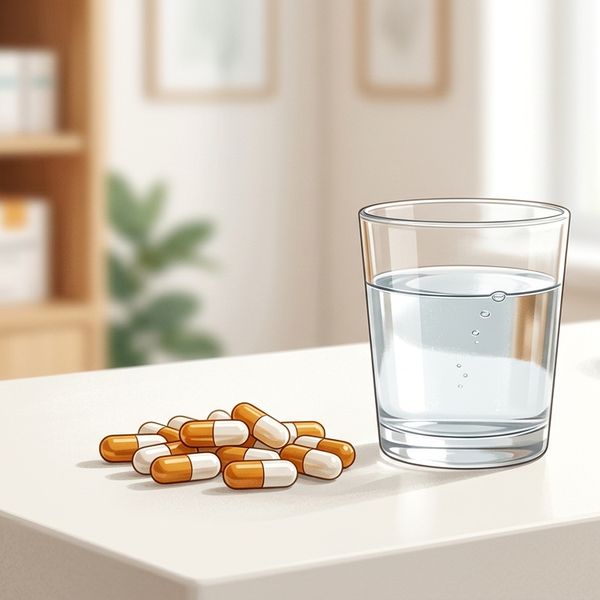
Here's the plain version: nitrofurantoin mono-MCR 100 mg is the generic of Macrobid. It's an antibiotic for bladder infections, you take one capsule twice a day with food, and the cash price is usually somewhere between $9 and $52 for a full course depending on where you fill it.
At a glance
- "Mono-MCR" and "mono/mac" both mean nitrofurantoin monohydrate/macrocrystals — the generic equivalent of Macrobid
- Standard adult dose for an uncomplicated UTI is 100 mg every 12 hours for 5 to 7 days, taken with food
- It only works in the bladder, so it won't treat a kidney infection
- Generic cash prices run about $9.14 at Cost Plus Drugs to $52 retail at Walmart for 14 capsules; brand Macrobid runs around $89 and up
- Brown or dark yellow urine while taking it is expected and harmless
What does "mono-MCR" actually mean on your label?
It's an abbreviation, and pharmacy systems truncate it differently depending on the software. All of these refer to the same product:
| What your label says | What it means |
|---|---|
| Nitrofurantoin mono-MCR 100 mg | Monohydrate/macrocrystals |
| Nitrofurantoin mono/mac 100 mg caps | Monohydrate/macrocrystals |
| Nitrofurantoin monohyd macro | Monohydrate/macrocrystals |
| Nitrofurantoin (monohydrate/macrocrystals) | Same thing, written out |
| Macrobid 100 mg | The brand name for this exact formulation |
The capsule holds two forms of the same drug. About 75% is nitrofurantoin monohydrate, which swells into a gel in your stomach and releases slowly. The other 25% is macrocrystalline nitrofurantoin, which is absorbed more gradually than the fine-crystal version. That dual-release design is the whole reason this one is dosed twice a day instead of four times.
Which brings up the other product people confuse it with.
Mono-MCR vs. macrocrystals: not the same prescription
There's a second nitrofurantoin product — plain nitrofurantoin macrocrystals, sold under the brand Macrodantin. It contains only the macrocrystalline form, it comes in 25 mg, 50 mg, and 100 mg capsules, and it's dosed four times a day.
| Nitrofurantoin mono-MCR (Macrobid) | Nitrofurantoin macrocrystals (Macrodantin) | |
|---|---|---|
| Strengths | 100 mg only | 25 mg, 50 mg, 100 mg |
| Typical UTI dose | 100 mg every 12 hours | 50–100 mg every 6 hours |
| Course length | 5–7 days | 7 days |
| Also used for | Acute uncomplicated UTI | Acute UTI and long-term prevention (50–100 mg at bedtime) |
This matters because of a very common mix-up: people search how to take nitrofurantoin four times a day, look at their mono-MCR bottle, and start doubling up. If your label says mono-MCR or mono/mac and 100 mg, it's twice daily. Four capsules a day of that formulation is twice the intended dose.
If the two instructions don't match, call the pharmacy that filled it. They can read the exact product off your record in under a minute.
What nitrofurantoin mono-MCR 100 mg is used for
The FDA indication is narrow on purpose: acute, uncomplicated urinary tract infections — bladder infections, also called acute cystitis — caused by susceptible strains of E. coli or Staphylococcus saprophyticus. E. coli causes the large majority of community UTIs, which is why this ends up being one of the most prescribed first-line options.
It works by concentrating heavily in urine rather than in blood and tissue. Great for the bladder. Useless almost everywhere else.
So nitrofurantoin for a UTI is not the right drug if the infection has moved up into the kidneys (pyelonephritis) or formed an abscess, because it never reaches high enough levels in that tissue. Signs that your infection isn't just a bladder infection: fever, chills, flank or mid-back pain, nausea and vomiting. Those need a different antibiotic and a same-day call to your provider.
It also does nothing for colds, flu, or anything viral.
Lower doses — usually 50 mg or 100 mg once at bedtime — are sometimes prescribed for months at a time to prevent recurrent UTIs. That's a different use with a different cost picture, covered further down.
Dosage: how to take it
For an uncomplicated bladder infection in adults, the standard is 100 mg every 12 hours for 7 days. Some prescribers write it for 5 days, which is also supported for uncomplicated cystitis in otherwise healthy women. Follow what's on your label rather than what a general article says.
A few details that change how well it works:
Take it with food or a glass of milk. This isn't just about avoiding nausea — food meaningfully increases how much drug your body absorbs. Taking it on an empty stomach makes a weaker course.
Swallow the capsule whole. Don't open, crush, or chew it. The slow-release gel matrix is the mechanism; breaking it defeats the point.
Space the doses about 12 hours apart. Morning and evening works fine. Eight hours apart isn't ideal but isn't dangerous — just return to a 12-hour rhythm with the next dose.
Finish the course. Bladder symptoms usually settle within 24 to 48 hours, which is exactly when people stop. Stopping early is the most common reason a UTI comes back a week later.
Missed a dose? Take it when you remember unless your next one is close, then skip it. Don't take two at once.
Savings tip: Before you leave the pharmacy counter, ask for the cash price even if you have insurance. For cheap generics like nitrofurantoin, the cash or discount-card price is sometimes lower than a $25 or $40 copay — and the pharmacist can run both, but usually only if you ask.
Nitrofurantoin mono-MCR 100 mg side effects
Most people get through a 7-day course with nothing worse than an unsettled stomach. The common nitrofurantoin side effects:
- Nausea (the most frequent complaint, and the main reason to take it with food)
- Headache
- Gas, stomach upset, loss of appetite
- Dizziness
- Diarrhea
- Dark yellow or brown urine — this one alarms people constantly. It's the drug coloring your urine. It's harmless and it stops when the course ends.
The rare but serious ones are worth knowing by name, because they're the reason this drug gets more cautious handling in older adults and in long-term use:
Lung reactions. Acute reactions can show up within the first week as fever, chills, cough, chest pain, and shortness of breath. A chronic form can develop after months of continuous use. New breathing trouble on nitrofurantoin is a stop-and-call-your-doctor situation, not a wait-and-see one.
Peripheral neuropathy. Numbness, tingling, burning, or weakness in the hands or feet. Risk goes up with impaired kidney function, anemia, diabetes, B vitamin deficiency, and long courses.
Liver injury. Rare, ranging from mild enzyme changes to hepatitis. Yellowing skin or eyes, dark urine paired with pale stools, or right-upper-abdominal pain all warrant a call.
Severe diarrhea from C. difficile. Possible with any antibiotic, sometimes weeks after finishing. Watery or bloody diarrhea with cramping needs medical attention — not an anti-diarrheal from the shelf.
Hemolytic anemia in people with G6PD deficiency. Sudden fatigue, pale skin, or shortness of breath.
Who shouldn't take it
- Anyone with significantly reduced kidney function — the drug can't concentrate in urine well enough to work, and side-effect risk climbs. Prescribers generally avoid it below a creatinine clearance of about 30 mL/min and weigh it carefully between 30 and 60
- Pregnancy at 38 to 42 weeks, during labor, or when labor looks imminent, because of hemolytic anemia risk in the newborn
- Infants under one month old
- Anyone with a prior nitrofurantoin-related liver reaction or jaundice
- G6PD deficiency, in most cases
One interaction that quietly ruins the course
Antacids containing magnesium trisilicate bind nitrofurantoin in the gut and block absorption. If you're taking an antacid during your course, check the label for magnesium trisilicate and switch products or separate the doses. Probenecid and sulfinpyrazone, both used for gout, slow the drug's clearance into urine, which also works against it.
Quinolone antibiotics like ciprofloxacin shouldn't be combined with nitrofurantoin — they can antagonize each other.
What nitrofurantoin mono-MCR 100 mg costs in 2026
Here's the useful part: the generic is genuinely cheap, and the gap between the worst and best price you can pay is wide enough to be worth two minutes of comparison shopping.
Prices below are for 14 capsules of 100 mg — a standard 7-day course — as of October 2026.
| Where you fill it | Cash / retail | With a discount card |
|---|---|---|
| Cost Plus Drugs (30 capsules) | $9.14 | — |
| Rx.com | $38.19 | $13.70 |
| Walmart | $52.08 | $15.29–$23.24 |
| CVS | $37.52 | $26.58 |
| Walgreens | $40.04 | $17.26–$31.78 |
| Brand Macrobid (Walgreens) | ~$89 | — |
Two things stand out. First, walking up without asking for a discount price can cost you three to five times more than necessary for the identical capsule. Second, the brand is roughly five to ten times the generic — and since the generic is nitrofurantoin monohydrate/macrocrystals, there's no clinical argument for paying for Macrobid unless your prescriber has a specific reason. Drugs.com puts brand Macrobid near $589 for 100 capsules; the generic equivalent quantity sits closer to $60–$90.
If your prescription was written for the brand and the price shocks you, the fix is usually one phone call asking whether a generic substitution is acceptable.
Where the cost actually hurts: long-term prevention
A single 7-day course is a $10 to $30 problem. Recurrent UTI prophylaxis is a different story — 50 mg or 100 mg nightly for six months or a year adds up, and that's where buying in volume changes the math.
Nitrofurantoin 100 mg through CanAmerica Plus runs $87.99 for 100 capsules, which works out to about $0.88 per capsule. For someone taking it nightly, that's roughly three months of coverage in one order. Cost Plus Drugs is competitive at this tier too. For a one-off 7-day course, a local pharmacy with a discount card is usually simpler and cheaper than ordering — we'd rather tell you that than pretend otherwise.
Compare per-capsule cost, not package price, whenever you're deciding between a 14-count and a 100-count fill.
If nitrofurantoin isn't the right fit
Kidney function, allergy, local resistance patterns, or an infection that's spread can all take this drug off the table. The usual alternatives, with CanAmerica Plus cash prices for context:
| Alternative | Typical UTI use | CanAmerica Plus price |
|---|---|---|
| Sulfamethoxazole/trimethoprim (Bactrim) | First-line where resistance is low; 3-day course | Not currently listed |
| Trimethoprim alone | Alternative when sulfa isn't tolerated | 100 mg and 200 mg listed |
| Ciprofloxacin | Reserved for complicated UTI or kidney involvement | $82.99 / 100 × 500 mg |
| Cephalexin | Option in pregnancy and sulfa allergy | $55.99 / 100 × 500 mg |
| Amoxicillin | Limited use — high E. coli resistance | $93.99 / 100 × 500 mg |
| Fosfomycin (Monurol) | Single-dose option | Not currently listed |
Resistance is the deciding factor more often than price, and it varies by region. This is a conversation for your prescriber, not a swap to make on your own. Our Macrobid for UTI guide covers how the brand version compares on dosing and price in more detail.
Phenazopyridine, sold over the counter as Azo and similar products, only numbs bladder pain. It treats the burning, not the bacteria, and it turns urine bright orange. Useful alongside an antibiotic; not a substitute for one.
The bottom line
Nitrofurantoin mono-MCR 100 mg is generic Macrobid: one capsule twice daily with food, five to seven days, for a bladder infection only. The label abbreviation is the confusing part, not the drug.
On cost, this is one of the rare prescriptions where almost nobody needs to overpay — ask for the cash or discount-card price before you pay a copay, skip the brand, and compare per-capsule pricing if you're on it long term for prevention. If you're filling it now, start by checking the nitrofurantoin price against what your pharmacy quoted you.
Frequently asked questions
What is nitrofurantoin mono-MCR 100 mg used for?
It treats acute, uncomplicated urinary tract infections — bladder infections caused by susceptible bacteria, most often E. coli. It concentrates in urine, so it doesn't treat kidney infections, respiratory infections, or anything viral. Lower nightly doses are sometimes used to prevent recurrent UTIs.
Is nitrofurantoin mono-MCR the same as Macrobid?
Yes. Macrobid is the brand name for nitrofurantoin monohydrate/macrocrystals 100 mg, and "mono-MCR" or "mono/mac" on a pharmacy label is the generic of that same formulation. It is not the same as nitrofurantoin macrocrystals (Macrodantin), which is dosed four times a day.
How long does nitrofurantoin take to work?
Most people notice burning and urgency easing within 24 to 48 hours. Complete relief can take a few days longer. If you're not improving at all after 48 hours, or you develop fever or back pain, contact your provider — that can mean a resistant organism or an infection that's reached the kidneys.
Can nitrofurantoin cause a yeast infection?
It can, though less often than broader-spectrum antibiotics. Any antibiotic can disrupt normal vaginal flora and allow yeast to overgrow. Itching and thick white discharge during or after a course are worth mentioning to your pharmacist, who can point you to an appropriate treatment.
What foods or medicines should I avoid with nitrofurantoin?
No foods need avoiding — take it with food for better absorption. Avoid antacids containing magnesium trisilicate, which block absorption. Tell your prescriber if you take probenecid or sulfinpyrazone for gout, or any quinolone antibiotic.
Is nitrofurantoin safe for older adults?
It's used in older adults, but more cautiously. Kidney function naturally declines with age, and reduced clearance both weakens the drug's effect in urine and raises the risk of lung and nerve side effects. Many prescribers check kidney function first and avoid long-term courses in this group.
This article is for informational purposes only and does not constitute medical advice. Always consult with a qualified healthcare provider for diagnosis and treatment. Pricing information is current as of the publication date but may change. Verify pricing directly before making purchasing decisions.