Braces Cost Without Insurance 2026: Real Prices
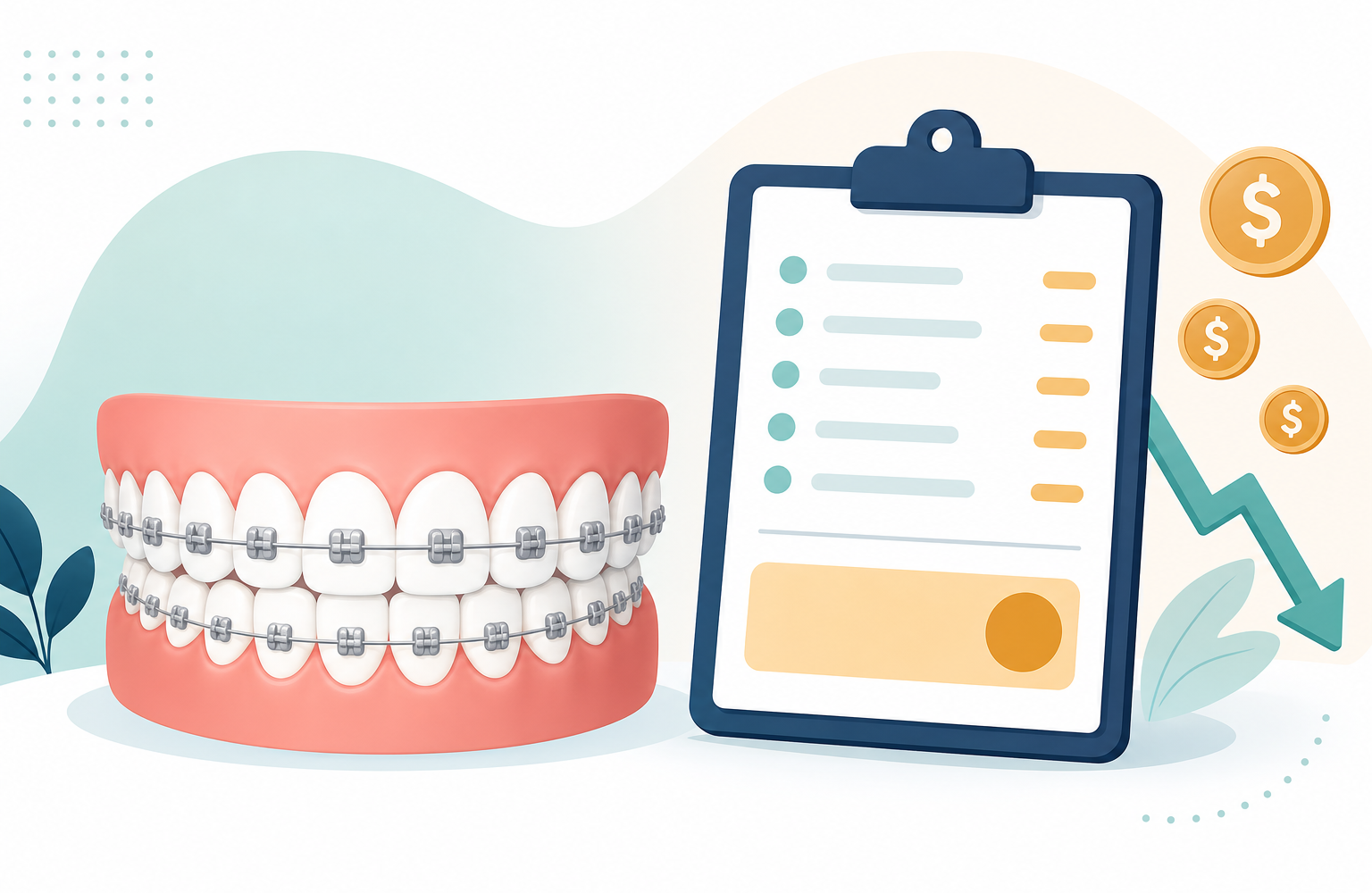
The consultation is free. The treatment coordinator slides a paper across the desk with one number on it — $6,400 — and asks how you'd like to handle the down payment.
Nobody tells you what's inside that number, whether it's negotiable, or whether the practice down the road would have quoted $4,800 for the same case. Braces cost without insurance is one of the few big medical expenses in America where the price is set per practice, quoted verbally, and almost never itemized unless you ask. Which means the spread between what you could pay and what you will pay is enormous.
At a glance
- Braces without insurance run $3,000 to $8,000 for a full course of treatment, with metal braces averaging $6,343 nationally and lingual braces reaching $17,411 at the top end.
- State averages for metal braces range from $4,767 in Indiana to $8,350 in Nevada — a $3,583 swing for identical treatment.
- Most quotes are a single bundled "treatment fee," and what it includes varies wildly. Records, retainers, and broken-bracket repairs are the three most common exclusions.
- Orthodontic residency clinics at dental schools typically charge 30% to 50% less, and paying in full upfront commonly earns a 5% to 10% discount at private practices.
- Buying dental insurance after you've decided on braces rarely pays off: ortho benefits carry 6–12 month waiting periods, a $1,000–$2,500 lifetime maximum, and usually an age cap.
How much do braces cost without insurance?
The honest answer is a range, and anyone who gives you one number without seeing your teeth is guessing.
Synchrony's 2023–2024 procedural cost study, which surveyed practices across all 50 states, puts the national average for metal braces at $6,343, with real quotes landing anywhere from $2,500 to $10,000. That's the most widely used dataset on US orthodontic pricing, and it lines up with what orthodontists themselves publish: most full treatments quote between $3,000 and $8,000.
Here's how the four main options compare.
| Type of braces | National average | Typical range | Treatment time | Visibility |
|---|---|---|---|---|
| Metal braces | $6,343 | $2,500 – $10,000 | 12–30 months | Visible |
| Ceramic (clear) braces | $5,834 | $4,480 – $11,312 | 12–24 months | Low |
| Clear aligners | $5,108 | $1,800 – $8,100 | 6–24 months | Near-invisible |
| Lingual braces | $9,221 | $7,321 – $17,411 | 12–36 months | Fully hidden |
Source: 2023–2024 Synchrony Average Procedural Cost Study.
Two things in that table surprise most people.
Clear aligners have the lowest national average, not the highest — because the average is dragged down by short Invisalign Express and Lite cases treating minor crowding. A full aligner case for a complex bite is priced right alongside metal braces, sometimes above.
And lingual braces are in a different universe. Every bracket is custom-milled to the back surface of an individual tooth, and placing them requires training most orthodontists don't have. That's what you're paying $9,000 for.
What braces cost in your state
Geography moves this price more than the type of bracket does.
| State | Average, metal braces | State | Average, metal braces |
|---|---|---|---|
| Indiana | $4,767 | Ohio | $7,127 |
| Alabama | $5,280 | Michigan | $7,193 |
| Wyoming | $5,363 | New Jersey | $7,283 |
| Georgia | $5,786 | Missouri | $7,280 |
| New York | $5,807 | Louisiana | $7,509 |
| California | $6,087 | Kansas | $7,735 |
| Texas | $6,504 | Nevada | $8,350 |
Source: 2023 Synchrony Average Procedural Cost Study, metal braces, all 50 states and DC.
New York averaging $5,807 while Kansas averages $7,735 breaks the usual assumption that cities cost more. Orthodontic pricing tracks local competition far more than local cost of living — dense metros have dozens of practices fighting for the same patients, while a single-orthodontist county has no pressure to discount.
If you live within driving distance of a state line or a bigger metro, get a quote on both sides of it. You'll be making that drive every 4 to 8 weeks for two years, so weigh the gas and the time off work. But a $2,000 spread justifies a lot of driving.
What's actually inside the quote
This is where the money hides, and it's the single thing the pricing pages online never break down.
Most orthodontists quote a bundled total treatment fee. Some bundle nearly everything. Others bundle the brackets and the adjustments, then bill separately for the rest. Two practices can quote $5,500 and $6,200, and the $6,200 one can be cheaper by the time you're finished.
Here's what each piece typically costs when it's billed on its own.
| Line item | Typical cost | Usually included? |
|---|---|---|
| Initial consultation | $0 – $250 | Often free |
| Diagnostic records (X-rays, photos, 3D scan) | $250 – $500 | Sometimes separate |
| Bonding and banding (placement) | Bundled | Yes |
| Routine adjustment visits | $75 – $150 each | Usually included |
| Broken bracket or loose wire repair | $50 – $200 per visit | Frequently not |
| Tooth extraction, if needed | $150 – $400 per tooth | No — separate provider |
| Palatal expander | $1,500 – $3,000 | No |
| First set of retainers | $150 – $500 | Sometimes |
| Replacement retainer | $150 – $400 | No |
| Treatment extending past the estimate | Varies | Ask explicitly |
Twenty-four months of treatment with two broken brackets, records billed separately, and retainers excluded adds $700 to $1,400 to a quote that looked all-inclusive.
Savings tip: Ask for the treatment fee in writing with an itemized list of what it covers, and ask these four questions specifically — Are diagnostic records included? Are emergency repair visits included? Are retainers included, and how many sets? What happens to the fee if treatment runs longer than estimated? Any practice that won't answer those in writing is telling you something.
The Phase 1 trap for kids
Orthodontists often recommend early interceptive treatment — "Phase 1" — for children around ages 7 to 10, using expanders or partial braces to guide jaw growth before all the permanent teeth arrive.
Sometimes it's genuinely necessary. Crossbites, severe crowding, and a narrow palate are much easier to fix while a child is growing.
But Phase 1 runs $1,000 to $3,500, and it doesn't replace full braces. Most Phase 1 kids still need a full Phase 2 course at age 12 or 13, at close to the standard fee. Families budgeting for one treatment discover they're paying for two, spread across five or six years — often $8,000 to $10,000 total.
Ask directly: "If we wait until all the permanent teeth are in, does this become harder to treat, or just the same treatment later?" If the answer is "the same treatment later," waiting saves you the entire Phase 1 fee. If there's a real functional reason — the bite is damaging teeth, a jaw discrepancy is worsening — that's a different conversation, and worth having with a second orthodontist too.
Cheaper ways to get braces
Every option below is legitimate. They trade money for time, convenience, or supervision, and which trade makes sense depends on your case.
| Option | Typical savings | The trade-off |
|---|---|---|
| Orthodontic residency clinic (dental school) | 30% – 50% off | Longer appointments, waitlists, resident treats you |
| Pay in full upfront | 5% – 10% off | Requires cash on hand |
| Dental savings plan | 15% – 25% off ortho | Only at participating providers |
| In-house 0% payment plan | No discount, spreads cost | Down payment usually required |
| Metal instead of ceramic or lingual | $1,000 – $3,000 | Visible brackets |
| Medicaid / CHIP (under 21) | Full coverage | Medical necessity only |
| Nonprofit access programs | Reduced or free | Income limits, long waitlists |
Orthodontic residency clinics are the most underused option in that table. There are roughly 70 accredited orthodontic residency programs in the US, attached to university dental schools. Treatment is performed by a licensed dentist completing specialty training, under the direct supervision of board-certified faculty. Cases are frequently more scrutinized than in private practice, because a faculty member signs off on every treatment decision.
The cost is appointments that run two to three hours instead of twenty minutes, waitlists that can stretch months, and the possibility your resident graduates mid-treatment and hands your case to another. For a straightforward case on a tight budget, saving $2,500 is worth all three.
Prepayment discounts are real and almost never advertised. Most private practices will take 5% to 10% off the total for payment in full at the start, because it eliminates their collections risk. On a $6,000 case that's $300 to $600 for asking one question. Say it plainly: "What's your discount for paying the full treatment fee upfront?"
Savings tip: If your employer offers an FSA, your entire annual election is available on January 1 — not accrued month by month like a 401(k). Orthodontia is an IRS-qualified expense, so you can front-load a braces down payment with pre-tax dollars in the first week of the plan year. Depending on your bracket, that's an effective 20% to 35% off. HSA funds work the same way but only up to your current balance.
Should you buy dental insurance for braces?
Usually not, and the reason is in the fine print rather than the premium.
Individual dental plans run roughly $25 to $60 a month. Orthodontic benefits, where they exist, typically look like this: 50% coinsurance up to a lifetime maximum of $1,000 to $2,500, a waiting period of 6 to 12 months before ortho benefits activate, and an age cap that excludes adults entirely on most standard plans.
Run the math on a $6,000 case. A plan at $45 a month with a 12-month waiting period and a $1,500 lifetime ortho max costs you $540 in premiums during the wait, plus another $1,080 across the 24 months of treatment. You pay $1,620 to receive $1,500. That's before the deductible.
Two exceptions change the answer. If you're insuring a child and the plan has no waiting period, or a short one, the math can work — children's orthodontic coverage is far more common than adult coverage. And if you already have coverage through an employer, use it: someone else is paying the premium.
Most plans also exclude "work in progress," meaning braces already on your teeth when the policy starts. Buying a plan mid-treatment usually gets you nothing.
Dental savings plans are a different product and worth knowing about. They aren't insurance — you pay $100 to $200 a year for access to a network of dentists who've agreed to discounted fees, typically 15% to 25% off orthodontics. No waiting period, no annual maximum, no claims. The catch is that the savings only exist at participating providers, so confirm a specific orthodontist you'd actually use is in the network before paying the membership fee.
What about mail-order aligners?
Direct-to-consumer aligner companies advertise $1,200 to $2,500 for a full course, which is a third of what an orthodontist charges. That gap is real, and so is the reason for it.
Nobody examines your teeth in person. Nobody takes X-rays to check the bone and roots before applying force to them. Tooth movement without radiographic monitoring can cause root resorption, bite collapse, and gum recession — problems that cost far more to correct than the original treatment would have cost to do properly.
The category has also proven unstable. SmileDirectClub, once the largest player in the space, shut down abruptly in December 2023, leaving customers mid-treatment with no provider and no refunds.
For genuinely minor crowding on a healthy mouth, remote aligners have worked for plenty of people. For anything involving bite correction, extractions, or existing gum disease, the cheaper option is the one that doesn't require corrective treatment afterward.
The costs after the braces come off
Treatment doesn't end at debonding, and the budget shouldn't either.
Retainers cost $150 to $500 for the first set. Teeth shift for life, so most orthodontists now recommend wearing a retainer at night indefinitely rather than for a fixed period. Clear retainers wear out, crack, and get thrown away in restaurant napkins — plan on replacing them every two to four years at $150 to $400 a set. Over twenty years that's a real number.
Ask whether your quote includes retainers and how many sets. If it doesn't, ask what a duplicate set costs at the same appointment — ordering two at once is usually much cheaper than coming back for a replacement in three years.
Braces also make teeth harder to clean, which raises the risk of white spot lesions and gum inflammation. A prescription-strength fluoride toothpaste and more frequent cleanings are common during treatment. If a gum infection does develop, an antibiotic like amoxicillin is a standard treatment, and patients with certain heart conditions may need a single premedication dose before banding appointments.
Savings tip: Cleanings every six months become more important with braces on, and those are a self-pay cost too. Our guide to teeth cleaning cost without insurance covers how to get the cash price by procedure code — the same approach works on orthodontic quotes.
The bottom line
Budget $3,000 to $8,000 for braces without insurance, and treat the first quote as a starting point rather than a price. Get three quotes, ask each one to itemize what the treatment fee includes, ask every practice what their prepayment discount is, and check whether a university orthodontic residency program is within driving distance before you sign anything.
If you're weighing dental insurance, run the actual numbers first — premiums plus waiting period against a lifetime maximum that's usually smaller than a year of premiums.
For related self-pay pricing, our breakdowns of wisdom teeth removal cost and eye exam cost apply the same math to other services people pay for out of pocket.
Frequently asked questions
How much do braces cost per month without insurance?
Most orthodontists spread the treatment fee across the length of treatment at 0% interest, which works out to roughly $150 to $350 a month on a $4,000 to $8,000 case over 18 to 24 months, after a down payment of $500 to $1,500. The monthly figure isn't a separate price — it's the same total fee divided up. Ask what the down payment is and whether it's negotiable, because that number varies more between practices than the monthly amount does.
How much are braces for adults without insurance?
Adult treatment is priced the same as adolescent treatment — $3,000 to $8,000 depending on type and complexity — but adults more often choose ceramic or lingual brackets, which pushes the average higher. Adult bone is denser, so treatment sometimes runs a few months longer. The bigger difference is coverage: most dental plans exclude adult orthodontics entirely, so adults are far more likely to be paying the full fee.
What's the cheapest way to get braces?
An orthodontic residency clinic at a dental school, typically 30% to 50% below private practice rates, combined with choosing metal brackets over ceramic and paying in full upfront for the additional 5% to 10% discount. Stacking those three can bring a $6,000 case under $3,000. The trade is longer appointments and a waitlist.
Does Medicaid cover braces?
Medicaid and CHIP cover orthodontic treatment for children under 21 when it's medically necessary — not for cosmetic crowding. States use scoring systems like the HLD index to determine eligibility, and qualifying conditions generally involve difficulty chewing, speech problems, severe jaw discrepancies, or cleft-related conditions. Adult coverage is rare and usually limited to reconstruction after facial trauma. Criteria vary by state, so check with your state Medicaid office rather than assuming.
Can you negotiate the cost of braces?
To a degree, yes — more than most people try. Prepayment discounts, a lower down payment, a longer payment term, and choosing a cheaper bracket type are all genuinely negotiable. Bringing a written quote from another practice sometimes moves the number. What's rarely negotiable is the base fee itself, since orthodontists price against their own overhead and chair time.
Are cheaper braces worse?
Not automatically. A lower quote often reflects lower overhead, less competition, metal instead of ceramic, or a simpler case — none of which affect outcome. What does matter is who is treating you and what's included. Verify the provider is a licensed orthodontist or a supervised resident, and confirm what the fee covers. A cheap quote that excludes records, repairs, and retainers isn't cheap.
This article is for informational purposes only and does not constitute medical advice. Always consult with a qualified healthcare provider for diagnosis and treatment. Pricing information is current as of the publication date but may change. Verify pricing directly before making purchasing decisions.