Wisdom Teeth Removal Cost Without Insurance 2026
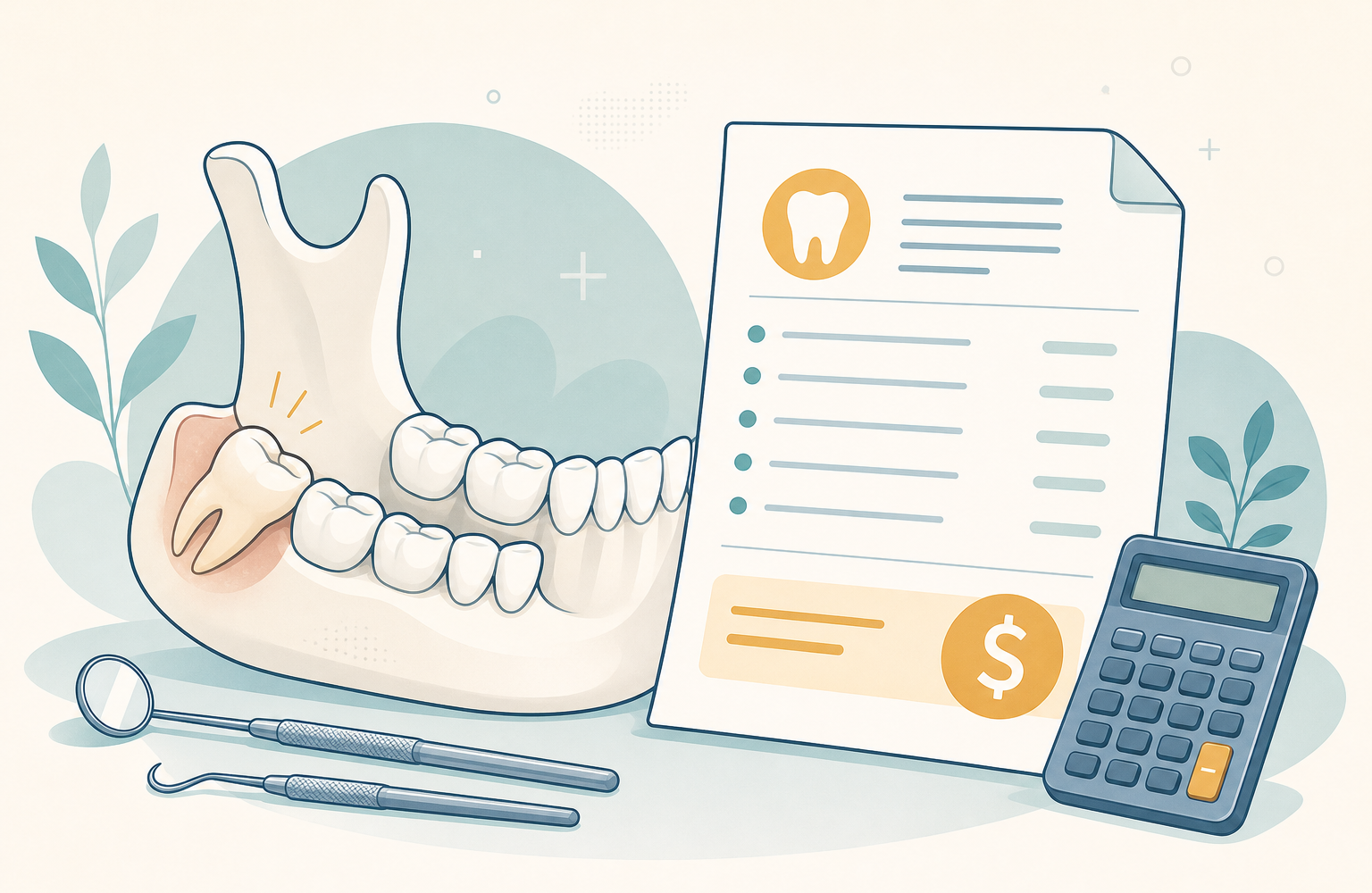
You go in for a checkup because something at the back of your jaw has started to ache, and you walk out holding a treatment plan for $2,400. Four teeth, IV sedation, a scan you didn't know you needed. No insurance card to soften it.
That number is real, and so is the fact that plenty of people pay less than half of it for the same four teeth. Wisdom teeth removal cost without insurance depends far more on how the teeth are sitting in your jaw and who puts you to sleep than on anything you can control — but the pieces you can control are worth several hundred dollars, and almost nobody tells you which ones they are.
At a glance
- A simple extraction of a fully erupted wisdom tooth runs roughly $75–$300 per tooth self-pay; a fully bony impaction runs $350–$1,200.
- All four teeth with sedation typically totals $1,200–$3,000, though published estimates stretch as high as $4,175.
- Anesthesia is the single biggest swing factor — local is usually bundled into the extraction fee, while IV sedation or general anesthesia adds $250–$900 to the visit.
- Dental schools commonly charge 30%–60% less than private practice for the same surgery, performed by residents under faculty supervision.
- Nearly every quote is negotiable, but only if you ask for the self-pay fee schedule by procedure code before you accept the treatment plan.
How much does wisdom teeth removal cost without insurance?
The published ranges disagree wildly, and it's worth knowing why before you anchor on any one of them.
Aspen Dental reports an average of $299 per tooth from its 2026 internal data, with a range of $184 to $488. Cigna's knowledge center puts wisdom tooth removal at $120–$800 per tooth. GoodRx says $200–$1,100 per tooth. CareCredit quotes $1,200–$4,175 for all four. Those figures aren't contradicting each other so much as describing different teeth.
A wisdom tooth that has fully erupted through the gum can often be lifted out in a few minutes with local anesthetic. A tooth sitting sideways, fully encased in jawbone, needs an incision, bone removal, and usually sectioning of the tooth into pieces. Same appointment name. Completely different procedure, and the fee follows the work.
Here's the more useful breakdown — by what's actually done, with the dental procedure code that appears on your treatment plan.
| What's being done | CDT code | Typical self-pay, per tooth |
|---|---|---|
| Simple extraction, fully erupted tooth | D7140 | $75 – $300 |
| Surgical extraction, erupted (needs bone removal or sectioning) | D7210 | $225 – $600 |
| Impacted — soft tissue only | D7220 | $250 – $600 |
| Impacted — partially bony | D7230 | $300 – $800 |
| Impacted — completely bony | D7240 | $350 – $1,200 |
Those codes matter more than they look. They're the standard ADA codes every US dental office uses, and they're how you compare two quotes honestly. A practice quoting $450 per tooth under D7240 and a practice quoting $450 under D7140 are not offering you the same deal.
About 90% of people have at least one impacted wisdom tooth, according to figures cited by the American Association of Oral and Maxillofacial Surgeons — so most people land somewhere in the bottom three rows of that table rather than the top one.
What's actually on the bill
The extraction fee is not the bill. It's usually a little over half of it.
| Line item | CDT code | Typical self-pay charge |
|---|---|---|
| Consultation / oral exam | D0140, D0150 | $50 – $150 |
| Panoramic X-ray | D0330 | $100 – $250 |
| Cone beam CT (3D scan) | D0367 | $150 – $500 |
| Extraction, per tooth | D7140–D7240 | $75 – $1,200 |
| Nitrous oxide ("laughing gas") | D9230 | $50 – $125 |
| IV moderate sedation, first 15 min | D9239 | $250 – $450 |
| IV sedation, each added 15 min | D9243 | $75 – $175 |
| Deep sedation / general anesthesia | D9222, D9223 | $400 – $900 |
| Post-op follow-up visit | — | $0 – $100 |
| Post-op prescriptions | — | $10 – $40 |
Two of those lines deserve a closer look, because they're where quotes diverge most and where a single question can change the number.
The cone beam CT is a 3D scan of your jaw. It's genuinely useful when a lower wisdom tooth sits near the inferior alveolar nerve and the surgeon needs to know exactly how close. It's also routinely added when a standard panoramic X-ray would have answered the question. Ask which one your case needs and why. If you've had a panoramic X-ray elsewhere in the last six months, ask whether they'll accept it — many will, and that's $150–$500 saved. (Self-pay imaging pricing follows similar logic in medicine; our CT scan cost guide covers the same dynamic on the medical side.)
The anesthesia line is the other one.
Anesthesia is where the price really moves
There are four levels, and the gap between the cheapest and the most expensive is bigger than the gap between a simple and a surgical extraction.
Local anesthetic — an injection that numbs the area. You're fully awake. This is almost always bundled into the extraction fee at no separate charge, and for straightforward erupted teeth it's frequently all that's needed.
Nitrous oxide — the gas mask. Takes the edge off anxiety, wears off in minutes, and you can usually drive yourself home. Adds $50–$125 to the visit. The best value on the menu if you're nervous but don't need to be unconscious.
IV moderate sedation — you're conscious but drowsy and won't remember much. Billed in 15-minute increments, which is the part people miss. A first unit at $250–$450 plus three more at $75–$175 each turns into $475–$975 quickly. Ask how many units they expect to bill, not just what the first one costs.
Deep sedation or general anesthesia — fully asleep, IV medication, usually requiring an oral surgeon or dental anesthesiologist. $400–$900 and up, on top of everything else.
Savings tip: Ask this exact question at the consultation — "Is local anesthesia alone clinically reasonable for my case, and if not, why?" For fully erupted or soft-tissue impactions, the answer is often yes. That single question can take $300–$800 off the total, and a surgeon who can't explain why you need sedation is worth a second opinion.
What all four teeth actually cost: four realistic scenarios
Averages are useless when you're trying to budget. Totals are what matter. These reflect the ranges above assembled into complete visits.
| Scenario | What's involved | Realistic self-pay total |
|---|---|---|
| Four erupted teeth, general dentist | Exam, panoramic X-ray, 4 × D7140, local only | $600 – $1,400 |
| Two erupted + two partial bony, general dentist | Exam, X-ray, 2 × D7140, 2 × D7230, nitrous | $1,100 – $2,200 |
| Four full bony impactions, oral surgeon | Exam, CBCT, 4 × D7240, IV sedation | $2,200 – $4,200 |
| Four impactions at a dental school | Same procedures, resident-performed, IV sedation | $900 – $1,800 |
That last row is not a rounding error. It's the same surgery.
Dental schools charge far less for the same procedure
There are roughly 70 accredited dental schools in the United States, plus a separate set of hospital-based oral and maxillofacial surgery residency programs. Both run clinics that treat the public, and both price well below private practice — commonly 30% to 60% less.
The work is performed by residents or senior students, supervised by faculty who are practicing oral surgeons. For a procedure as standardized as a third molar extraction, that supervision structure is a reasonable trade for the price.
What you give up is time. Expect a screening appointment first, which may or may not accept you as a case. Expect a waitlist that can run weeks to months. Expect the surgery itself to take longer than it would in private practice, because a resident works more deliberately and a faculty member checks the work. If your tooth is actively infected and painful, this route may simply be too slow — but if you're planning ahead, it's the largest single discount available.
Two other places worth a call before you accept a private-practice quote:
- Federally qualified health centers with dental programs, which use sliding-scale fees tied to household income.
- Oral surgery residency clinics at teaching hospitals, which sometimes take cases dental schools won't.
How to negotiate the cash price
Dental fees are not fixed the way people assume. Practices maintain a self-pay schedule that differs from their insurance-contracted rates, and they rarely lead with it. Work through this in order — the sequence matters, because each step depends on the one before it.
- Get the treatment plan in writing with CDT codes on it. Not a verbal estimate. Not a total. The itemized plan with codes. Every practice can produce this in about ninety seconds.
- Ask for the uninsured or self-pay fee schedule by name. The phrasing matters: "What is your self-pay fee for D7230?" A round-number quote for "wisdom teeth" is a starting position.
- Ask about a prepayment discount. Paying in full on the day of service commonly earns 5%–10% off. It's rarely offered unprompted.
- Ask whether all four teeth need to come out now. If two are asymptomatic and fully erupted, removing two teeth this year is a legitimate option to raise.
- Ask whether a general dentist can do it. Many general dentists handle erupted and soft-tissue impactions and charge less than an oral surgeon. Full bony impactions near the nerve are a different matter — that's what surgeons are for.
- Get a second quote. Two consultations in the same city routinely differ by $700 or more on identical work. The consultation fee is $50–$150; the spread is worth it.
- Ask for a package price on all four. Removing them in one appointment saves a second round of anesthesia setup and often earns a bundled fee.
One more thing worth knowing: dental savings plans (sometimes called discount dental plans) are not insurance. You pay an annual membership — typically $100–$200 — for access to a discounted fee schedule at participating dentists, with no waiting period and no annual maximum. For a single $2,000 procedure they can be worth the math. Confirm the specific practice participates and that extractions are included before you pay for one.
The prescriptions afterward are the cheap part
This is the honest version: medication is a small line on a wisdom teeth bill, and it would be misleading to suggest otherwise.
For pain, the current evidence favors alternating over-the-counter ibuprofen and acetaminophen over opioids for third molar surgery — better pain control, fewer side effects, and roughly $15 at any pharmacy. Most people don't need a prescription painkiller at all.
Antibiotics are prescribed when there's an active infection before surgery, or occasionally after a difficult extraction. Amoxicillin is the usual first choice. Metronidazole is sometimes added for anaerobic infections, and clindamycin is the standard alternative for people with a penicillin allergy. A short course of any of these generally runs $10–$30 cash at a US pharmacy.
Cash-pay pricing on larger quantities is where a service like CanAmerica Plus fits, and it's a modest saving rather than a dramatic one at this scale — as of August 2026, amoxicillin 500 mg is listed at $92.99 for 100 tablets and metronidazole 500 mg at $54.99 for 100 tablets. Useful if you're managing a recurring dental infection or filling other prescriptions at the same time. Not the reason your wisdom teeth bill is $2,400.
Complications that add to the bill
Dry socket is the common one — the blood clot in the socket dislodges early, exposing bone, and it hurts considerably more than the surgery did. Treatment is a medicated dressing placed in the socket, billed under D9930, typically $50–$150 per visit. Some practices include it in the surgical fee for a set period afterward. Ask.
Infection after extraction means an office visit plus antibiotics — usually $75–$200 all in.
Nerve injury is rare but real for lower wisdom teeth close to the inferior alveolar nerve, causing numbness in the lip or chin that's usually temporary. This is the specific situation where a 3D scan earns its cost, and where an oral surgeon rather than a general dentist is the right call.
You may not need all four removed
The strongest cost-control move is questioning the premise, and the professional consensus here is genuinely unsettled.
A 2020 Cochrane review of surgical removal versus retention of asymptomatic, disease-free impacted wisdom teeth found insufficient evidence to support or refute routine preventive extraction. The American Public Health Association has a standing policy opposing prophylactic removal of third molars. The American Association of Oral and Maxillofacial Surgeons supports surgical management of third molars likely to cause problems. The American Dental Association recommends extraction of partially erupted wisdom teeth where there's risk of infection, damage to neighboring teeth, or cysts.
Read those together and a reasonable position emerges. A wisdom tooth that hurts, is decayed, is partially erupted and trapping bacteria, or is pushing on the tooth in front of it has a clear case for removal. A tooth that's fully impacted, fully covered, symptom-free, and not causing problems has a much weaker one.
If you're staring at a four-tooth plan and only one tooth is bothering you, ask directly: what is the specific problem with each of the other three, and what happens if we monitor them instead? A good surgeon will have an answer for each tooth individually. That conversation is free, and it's the only thing on this page that can take the bill to zero.
And if a wisdom tooth is throbbing at 11 p.m., the emergency room is the wrong door — an ER can give you antibiotics and pain relief but cannot extract the tooth, so you pay for a visit and still need the surgery. Our guides to ER visit cost and urgent care cost without insurance break that math down.
The bottom line
Budget $75–$300 per tooth for a simple extraction and $350–$1,200 per tooth for a full bony impaction, with all four typically landing between $1,200 and $3,000 once sedation is included. Get the treatment plan in writing with the CDT codes, ask what the case actually requires versus what's being offered, and price a dental school before you accept a private-practice quote.
Then ask the question most people skip — whether every tooth on that plan needs to come out at all.
Frequently asked questions
How much does it cost to remove 2 wisdom teeth without insurance?
Two erupted wisdom teeth typically run $150–$600 total for the extractions, plus $150–$400 for the exam and X-ray. Two impacted teeth run $600–$2,400 for the extractions alone, and sedation adds $50–$900 depending on the level. Most people having two teeth removed pay somewhere between $500 and $1,800 all in.
How do I get my wisdom teeth removed if I can't afford it?
Start with a dental school clinic — roughly 70 accredited US dental schools run public clinics at 30%–60% below private practice, and hospital oral surgery residency programs do the same. Federally qualified health centers with dental services use sliding-scale fees based on income. Beyond that, ask any private practice for its self-pay fee schedule, a prepayment discount, and an interest-free payment plan. Many practices offer all three but volunteer none of them.
Will dental insurance fully cover wisdom teeth removal?
Rarely. Most plans classify impacted extractions as a major procedure covered at 50%, with erupted extractions treated as basic care at around 80%. Nearly all plans also carry an annual maximum — often $1,000 to $2,000 — so a four-tooth surgical case can exhaust the yearly benefit and leave the remainder on you. Many plans also impose a waiting period of six to twelve months before covering major work.
Is $2,000 a lot for wisdom teeth removal?
It's within the normal range for four impacted teeth with IV sedation performed by an oral surgeon, and high for four erupted teeth under local anesthesia. The way to tell which situation you're in is the treatment plan: if the codes are D7230 or D7240 with a sedation line, $2,000 is reasonable. If they're D7140, it isn't, and it's worth a second quote.
Is it ever free to get wisdom teeth removed?
Occasionally. Some dental schools run free care days, some charitable dental clinics hold periodic free events, and Medicaid covers extractions for children in every state and for adults in about half of them. Original Medicare does not cover dental extractions, though some Medicare Advantage plans include dental benefits that do. Free options generally require patience and a screening appointment rather than an urgent timeline.
How much is wisdom teeth removal with anesthesia?
Add the anesthesia to the extraction fees rather than looking for a single number. Nitrous oxide adds $50–$125 to the visit, IV moderate sedation adds roughly $475–$975 once the 15-minute increments are counted, and deep sedation or general anesthesia adds $400–$900 and up. Four impacted teeth under IV sedation commonly totals $2,200–$4,200.
This article is for informational purposes only and does not constitute medical advice. Always consult with a qualified healthcare provider for diagnosis and treatment. Pricing information is current as of the publication date but may change. Verify pricing directly before making purchasing decisions.