ER Visit Cost Without Insurance 2026: Real Prices
You're in the waiting room at 2 a.m. with no insurance card, and somewhere behind the worry about what's actually wrong with you is a second, quieter worry: how much is this going to cost?
Here's the honest answer. ER visit cost without insurance in 2026 usually lands between $1,200 and $3,000 for a moderate visit, and the number climbs fast once imaging, procedures, or an admission enter the picture. A minor visit can come in under $700. A cardiac workup can pass $20,000.
At a glance
- A self-pay ER visit in 2026 typically runs $1,200–$3,000 for a moderate problem; minor visits start around $650 and critical care can exceed $20,000.
- The facility fee alone — the charge just for walking through the door — is usually $500–$1,500 before anyone touches you.
- The emergency physician bills separately from the hospital, so one visit generates two or more bills from two or more companies.
- Federal law requires the ER to screen and stabilize you regardless of ability to pay. It does not make the care free.
- Most hospitals will discount a self-pay bill 40%–60% if you ask — but the discount is almost never offered to you first.
How much does an ER visit cost without insurance?
The published estimates disagree with each other, and it's worth understanding why before you anchor on any single number.
A Peterson-KFF analysis of private insurance claims found that insurers and patients together paid an average of $2,453 per emergency department visit, with a quarter of visits costing $970 or less and a quarter costing $3,043 or more. That's the amount actually paid under negotiated rates. Uninsured patients don't get negotiated rates. They get billed off the hospital's chargemaster, which typically runs two to four times higher.
So the spread you see quoted online — anywhere from $800 to $3,000 for "a visit" — mostly comes down to three things: whether the figure counts the facility fee only or the whole bill, whether it reflects charges or payments, and how sick the person was.
Here's a more useful way to think about it. Ranges below reflect published self-pay estimates and claims analyses for 2026, combining the hospital's facility charge, the emergency physician's fee, and typical testing at each level.
| What kind of visit | Typical self-pay total |
|---|---|
| Minor — exam only, no imaging (sprain, small laceration, rash) | $650 – $1,400 |
| Moderate — basic labs plus one X-ray (UTI with fever, asthma flare) | $1,200 – $2,600 |
| High complexity — CT scan or extended workup (abdominal pain, head injury) | $2,400 – $5,500 |
| Critical — resuscitation, cardiac intervention, major trauma | $5,000 – $20,000+ |
Two numbers do most of the damage in that table, and neither of them is the doctor.
ER cost by severity level: the codes on your bill
Every ER visit gets assigned a level from 1 to 5, and that level sets the facility charge. On your itemized bill it appears as a CPT code between 99281 and 99285. Most people never look at it, which is a mistake — the level is assigned by a coder after the fact, and it's one of the few things on the bill you can actually challenge.
| Level | CPT code | Typical scenario | Facility charge, self-pay |
|---|---|---|---|
| 1 | 99281 | Minor, self-limited — small cut, prescription refill | $250 – $600 |
| 2 | 99282 | Low complexity — ear infection, simple sprain | $400 – $900 |
| 3 | 99283 | Moderate — urinary infection with fever, asthma flare | $700 – $1,500 |
| 4 | 99284 | High complexity — chest pain workup, fracture with imaging | $1,200 – $2,500 |
| 5 | 99285 | Critical — heart attack, stroke, major trauma | $2,000 – $5,000+ |
That is the facility charge only. Nothing in that column includes the physician, the labs, the scan, or the medication.
Two things worth knowing about these levels. First, the mix has shifted upward over time: Peterson-KFF found the share of level 5 claims has grown since 2004, and emergency coding has trended toward higher complexity for both facility and professional fees. Second, the range within a single level is enormous — in 2021 the top quarter of level 5 facility fees ran more than twice the bottom quarter, $1,352 versus $576. Same code, same care, wildly different price depending on the hospital.
What actually shows up on your ER bill
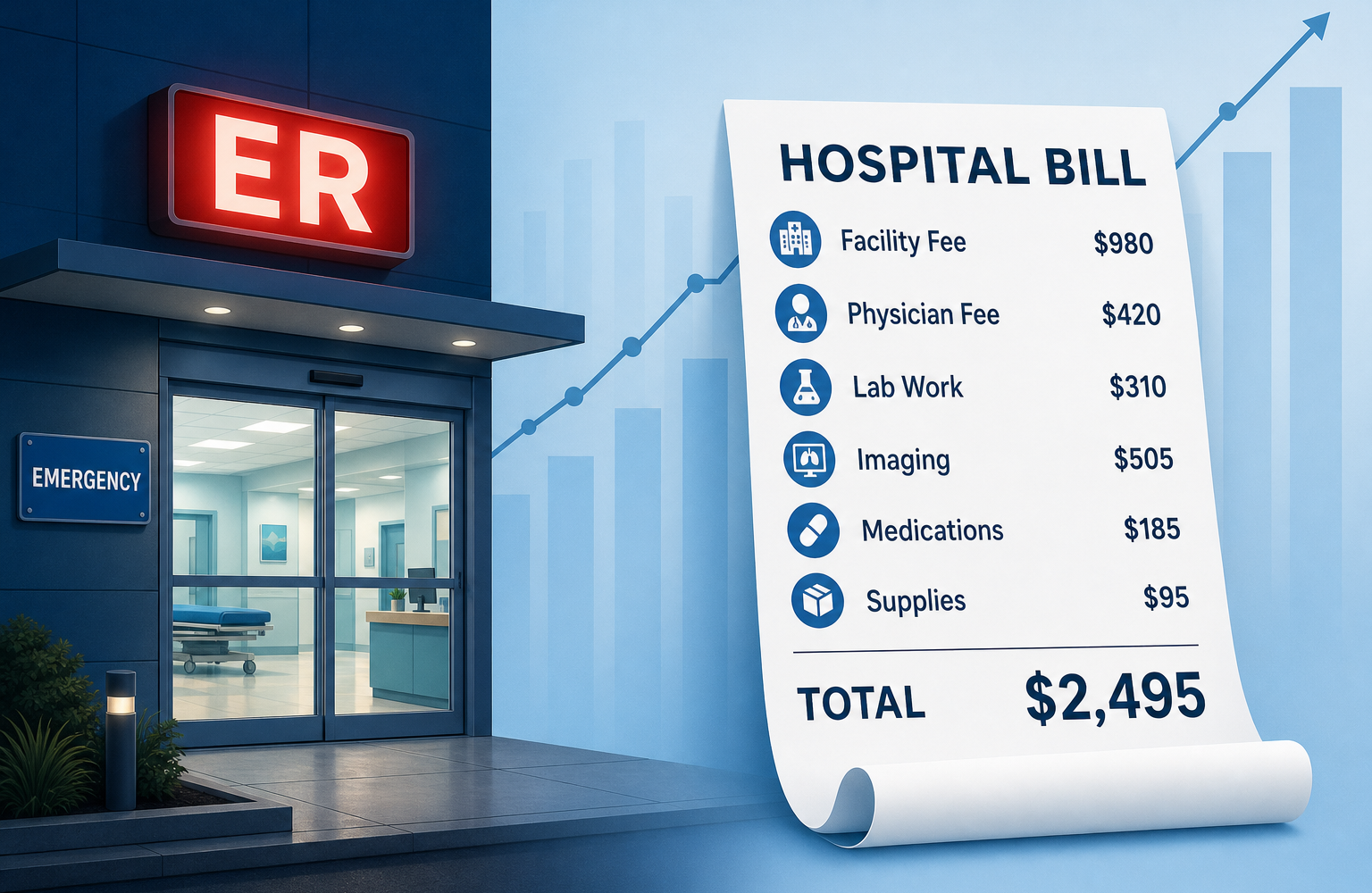
An emergency visit isn't one charge. It's a stack, and each piece is priced independently.
| Line item | Typical self-pay charge |
|---|---|
| Facility fee (the charge for the room and staffing) | $500 – $1,500 |
| Emergency physician fee (billed separately from the hospital) | $200 – $800 |
| Basic blood panel — CBC, metabolic | $100 – $500 |
| X-ray, one area | $200 – $500 |
| CT scan | $500 – $3,000 |
| Ultrasound | $200 – $800 |
| EKG | $150 – $300 |
| IV fluids | $200 – $800 |
| Stitches or wound repair | $200 – $1,000 |
| Splint or cast | $200 – $500 |
| Each medication administered | $50 – $500 |
| Specialist consultation | $300 – $1,000 |
| Ground ambulance | $400 – $2,500 |
The separate-billing problem catches almost everyone. The hospital sends one bill. The emergency physician group sends another. If a radiologist read your scan, that's a third. A pathologist reading a specimen is a fourth. People routinely assume they've settled up after paying the hospital, then get a $600 envelope from a physician group they've never heard of two months later.
Ask before you leave: is anyone besides the hospital going to bill me for today?
Why the same visit costs four times more across a state line
Geography drives more variation than severity does at the low end. Published 2026 estimates for an uninsured moderate-to-severe visit range from roughly $750 in Maryland — the one state that sets hospital rates for all payers — to nearly $3,750 in Florida. California, New Jersey, Colorado, and Nevada all cluster near the top.
Within a single metro, three factors matter more than the map.
Teaching hospitals cost more. Academic medical centers commonly run 20%–40% above a community hospital for identical care.
Freestanding ERs are a trap for the uninsured. They look like urgent care from the parking lot — strip mall, easy access, short wait. They bill at full emergency-room rates, facility fee and all. If the sign says "emergency" anywhere on it, assume ER pricing. Check before you walk in, not after.
Observation status is the cliff nobody warns you about. Being kept overnight "for observation" is outpatient care, billed under a different set of rules than an inpatient admission. For a self-pay patient it can produce a bill in the same range as admission without any of the protections. If you're being kept, ask directly whether you're admitted or under observation, and get the answer in writing.
Savings tip: Do not pay at the registration desk. Some hospitals treat a payment at time of service as a completed transaction, which can complicate or disqualify a later financial assistance application. Tell them you'd like to be billed and that you plan to apply for financial assistance. Paying later almost always costs less than paying at the counter.
You will be treated. You will also be billed.
The Emergency Medical Treatment and Labor Act (EMTALA) requires any hospital with an emergency department to give you a medical screening exam and, if you have an emergency condition, to stabilize you — regardless of insurance status or ability to pay. Registration can't be used to delay that screening.
What EMTALA does not do is make the care free. The hospital can, and will, bill you afterward. It also doesn't cover follow-up: once you're stable, the obligation ends.
That gap between "they have to treat me" and "they can still send me a $4,000 bill" is where most uninsured ER debt is created.
How to cut an ER bill you already have
If the envelope has already arrived, you have more room than you think. Work these in order.
1. Request an itemized bill before you pay anything. The summary statement is useless for disputes. Ask for the itemized version with CPT codes on it. Check for duplicated charges, medications you never received, and a severity level that doesn't match what happened to you. A level 4 code on a visit where you got an exam and a prescription is worth questioning.
2. Ask for the self-pay or prompt-pay discount by name. Most hospitals have one, in the range of 40%–60%, and most will not volunteer it. The exact phrasing matters: "What is your uninsured or self-pay discount rate?" Prompt-pay discounts of 10%–30% often stack on top if you settle within 30 to 90 days.
3. Apply for the hospital's financial assistance policy. Nonprofit hospitals are required under federal law to maintain one, and the income limits are more generous than people expect. Most cover patients up to 200%–400% of the federal poverty level. Using the 2026 HHS guidelines of $15,960 for an individual and $33,000 for a family of four, that works out to roughly:
| Threshold | Individual income up to | Family of four up to |
|---|---|---|
| 200% FPL | $31,920 | $66,000 |
| 300% FPL | $47,880 | $99,000 |
| 400% FPL | $63,840 | $132,000 |
Ask for the policy in writing. There's usually a form, and there's usually a deadline — often 240 days from the first bill.
4. Ask what the hospital's Medicaid rate is for the same service, then offer it. This works more often than it should. Billing departments would rather collect something than send an account to collections, and the Medicaid rate is a defensible number to anchor on.
5. Negotiate a lump sum. If you can pay a portion immediately, offer 30%–50% of the balance as full settlement. Get the agreement in writing before the money moves.
6. Take the interest-free payment plan if you can't settle. Most hospitals offer 6 to 60 months at no interest. It doesn't reduce the total, but it keeps the account out of collections.
7. Check whether you qualified for coverage retroactively. Medicaid can be applied retroactively in many states, and an unexpected ER visit is a qualifying life event for a special enrollment period on the marketplace in some circumstances. Worth one phone call before you accept the bill as final.
What happens if you simply don't pay
This deserves a straight answer, because the rules changed recently and a lot of advice online is out of date.
In January 2025 the Consumer Financial Protection Bureau finalized a rule removing medical debt from credit reports. On July 11, 2025, a federal court in the Eastern District of Texas vacated that rule. It is not in effect.
What still protects you is the voluntary policy the three major credit bureaus adopted in 2023, which remains in place: paid medical collections are removed from reports regardless of amount, unpaid medical collections under $500 are excluded entirely, and there's a one-year delay before an unpaid medical collection can appear at all.
Practically, that means a $400 ER balance is unlikely to touch your credit report. A $4,000 balance can, after a year, if it goes to collections. That one-year window is time to negotiate, not time to ignore the bill — unopened mail is how a negotiable balance becomes a judgment.
When the ER isn't the right door
Roughly 155 million emergency department visits happen in the US each year, according to the most recent CDC survey data. A meaningful share of them are for problems that a much cheaper setting could have handled.
| Where you go | Typical self-pay cost | Best for |
|---|---|---|
| Telehealth visit | $0 – $90 | UTIs, sinus infections, pink eye, rashes, refills |
| Retail clinic in a pharmacy | $99 – $150 | Strep, flu, minor illness, vaccines |
| Urgent care center | $145 – $250+ | Sprains, stitches, X-rays, on-site labs |
| Freestanding ER | Same as a hospital ER | Nothing, if urgent care is an option |
| Hospital emergency room | $1,200 – $3,000+ | Chest pain, stroke signs, trouble breathing, severe bleeding, head injury |
None of that applies when it's a real emergency. Chest pain, stroke symptoms, difficulty breathing, uncontrolled bleeding, a serious head injury, or anaphylaxis — go, and sort the bill out afterward. A cheaper visit that misses a heart attack isn't cheaper. Our guide to urgent care cost without insurance covers the middle ground in more detail, and if a scan is what you're facing, the MRI and CT scan cost guides break down self-pay imaging prices separately.
The prescriptions attached to an ER visit
There are two medication costs tied to any emergency visit, and the smaller one gets all the attention.
The first is what you leave with. Discharge prescriptions after an ER visit are usually inexpensive generics — a course of antibiotics, something for nausea, a short steroid taper. Ten days of amoxicillin or cephalexin commonly runs $10 to $25 cash. Ondansetron, the generic of Zofran, and generic prednisone are similar. This is not where American healthcare gets expensive, and it would be dishonest to pretend otherwise.
The second cost is the one that actually matters, and it runs in the other direction: the chronic medication you stopped filling because it was too expensive.
Cost-related nonadherence is one of the better-documented drivers of avoidable emergency visits. Insulin rationing produces diabetic ketoacidosis. A skipped inhaler produces an asthma attack at 3 a.m. A missed anticoagulant raises stroke risk in atrial fibrillation. In each case a monthly prescription someone couldn't afford turns into a four-figure ER bill.
If any of these are the medication you've been stretching, pricing them through a cash-pay option is worth an afternoon:
| Medication | What skipping it can send you to the ER for |
|---|---|
| Lantus SoloStar (insulin glargine) | Diabetic ketoacidosis, severe hyperglycemia |
| Humalog KwikPen (insulin lispro) | Blood sugar crises |
| Ventolin / albuterol inhaler | Acute asthma attack |
| Symbicort | Asthma and COPD flares |
| Trelegy Ellipta | COPD exacerbation |
| Eliquis | Stroke or clot in atrial fibrillation |
| Xarelto | Stroke, DVT, pulmonary embolism |
| Jardiance / Farxiga | Heart failure decompensation |
| EpiPen Jr and adult epinephrine auto-injectors | Anaphylaxis without a rescue option |
An expired epinephrine auto-injector you didn't replace because of the price is the clearest version of this math. So is a $300 inhaler that becomes a $2,400 ER visit.
The bottom line
Budget $1,200–$3,000 for a moderate ER visit without insurance in 2026, understand that the facility fee and the physician fee arrive as separate bills, and treat the first number you're quoted as an opening position rather than a final one. Ask for the itemized bill, ask for the self-pay discount by name, and apply for financial assistance before you pay anything.
Then look at what put you there. If a prescription you couldn't afford is part of the story, comparing cash-pay pricing on it is a cheaper problem to solve than the next visit.
Frequently asked questions
How much is an ER visit without insurance?
Most self-pay emergency room visits in 2026 cost $1,200 to $3,000 for a moderate problem. A minor visit with no imaging can run $650 to $1,400, while critical care involving resuscitation or a cardiac procedure can exceed $20,000. The facility fee alone is typically $500 to $1,500 before any testing.
Can the ER turn you away if you have no insurance?
No. Under EMTALA, any hospital with an emergency department must provide a medical screening exam and stabilize an emergency condition regardless of your insurance or ability to pay, and registration cannot delay that screening. The hospital can still bill you afterward, and the obligation ends once you're stable.
What happens if you can't pay an ER bill?
Ask for an itemized bill, request the hospital's self-pay discount, and apply for its financial assistance policy — nonprofit hospitals are federally required to have one, and many cover incomes up to 400% of the federal poverty level. If the balance still stands, most hospitals offer interest-free payment plans. Unpaid medical collections under $500 are excluded from credit reports under the credit bureaus' voluntary policy, and there's a one-year delay before any unpaid medical collection can be reported.
Is it cheaper to go to urgent care than the ER?
Substantially, for anything that isn't life-threatening. A self-pay urgent care visit typically runs $145 to $250 versus $1,200 or more at an emergency room for a comparable complaint. Freestanding emergency centers are the exception — they look like urgent care but bill at full ER rates, so check the signage before you walk in.
Why is my ER bill so much higher than the average?
Three usual culprits: the visit was coded at a higher severity level than you'd expect, a CT scan or specialist consult was added, or you went to a teaching hospital or a high-cost state. Facility fees for the same code can vary more than twofold between hospitals. Request the itemized bill with CPT codes and check the level assigned against what actually happened during your visit.
This article is for informational purposes only and does not constitute medical advice. Always consult with a qualified healthcare provider for diagnosis and treatment. Pricing information is current as of the publication date but may change. Verify pricing directly before making purchasing decisions.