Januvia Generic 2026: Sitagliptin Cost & How to Save
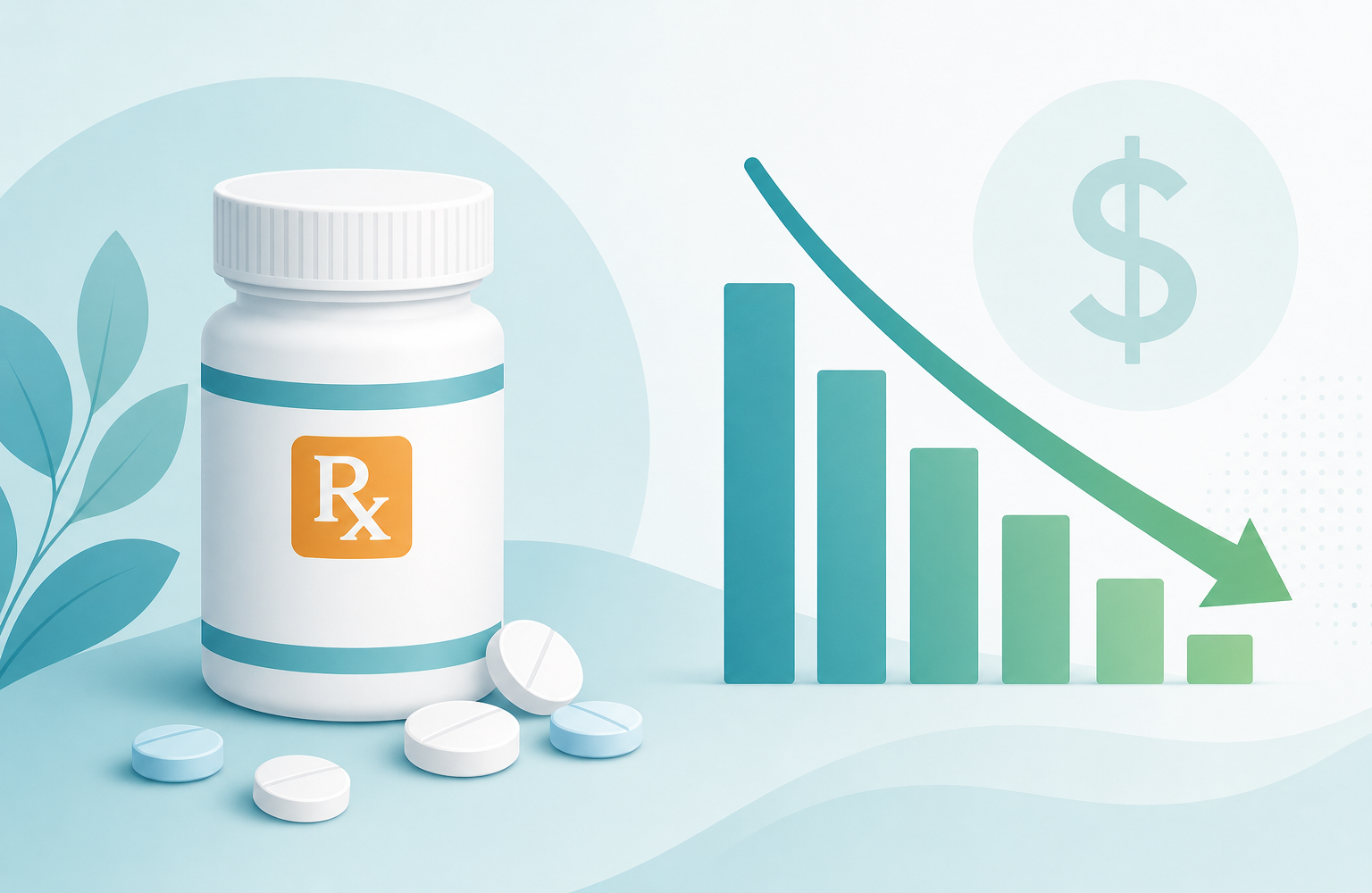
For years the answer to "is there a generic for Januvia?" was no. That changed. Generic sitagliptin is sitting on US pharmacy shelves right now, from Sandoz, Teva, and Apotex.
Here's the part nobody warned you about: it still costs around $268 for 30 tablets. A generic that prices like a brand name isn't much of a win, and if you walked into your pharmacy expecting a $15 copay-style price, you already know that.
At a glance
- Generic sitagliptin (the true generic for Januvia) reached US pharmacies in 2026 — Sandoz in January, Teva and Apotex on May 28
- Cash price for generic sitagliptin phosphate runs about $267.68 for 30 tablets as of August 2026, barely below brand pricing
- The last Januvia patent doesn't expire until November 24, 2026, which is why competition — and real price drops — are still building
- Through CanAmerica Plus, sitagliptin is $89.99 for 84 tablets and brand Januvia is $114.99 for 84 tablets
- Zituvio is not the same thing as generic Januvia, even though it contains sitagliptin
Is there a generic for Januvia in 2026?
Yes. The FDA has approved generic sitagliptin phosphate from three manufacturers, and all three have started marketing it.
| Manufacturer | FDA approval | On US pharmacy shelves |
|---|---|---|
| Watson Labs (Teva) | December 30, 2025 | May 28, 2026 |
| Sandoz | January 14, 2026 | January 14, 2026 |
| Apotex | January 20, 2026 | May 28, 2026 |
All three make the same three strengths as the brand: 25 mg, 50 mg, and 100 mg. All three carry an AB rating, meaning the FDA considers them therapeutically equivalent to Januvia and your pharmacist can substitute one for the other without calling your doctor.
If your refill came back looking different — a pink round tablet stamped TV 2Y, or a brown one stamped TV 3Y or TV 7Y — that's Teva's sitagliptin. Same drug. Different pill.
Why generic sitagliptin still costs almost as much as the brand
This is the question the older articles don't answer, and it's the one that actually affects your wallet.
Merck's key patent on sitagliptin phosphate — US Patent 7,326,708 — does not expire until November 24, 2026. A related pediatric exclusivity runs to May 24, 2027. So how are generics on the market already?
Settlements. Merck cut licensing deals with several generic manufacturers that let them launch early, in exchange for terms Merck negotiated. That's a limited, controlled launch, not the free-for-all that normally follows a patent cliff.
Three suppliers is not enough to collapse a price. Research on generic markets consistently shows you need something closer to five or six competing manufacturers before prices fall 80% or more. With three — two of whom only began shipping in late May — the discount off brand pricing has been modest.
Current cash prices, per the Drugs.com price guide as of August 2026:
| Product | 30 tablets | Per tablet |
|---|---|---|
| Sitagliptin phosphate (generic Januvia) | $267.68 – $271.14 | $8.92 – $9.04 |
| Sitagliptin base (generic Zituvio) | $246.22 | $8.21 |
| Brand Januvia, average US retail | roughly $708 | roughly $23.60 |
The generic saves you something. It does not save you what a generic normally saves you.
Januvia, sitagliptin, Zituvio: what's actually in the bottle
Three names, one active ingredient, and a distinction that trips up almost everyone.
Januvia is Merck's brand, FDA-approved in October 2006. The active ingredient is sitagliptin phosphate.
Generic sitagliptin phosphate is the true generic — same salt, same strength, AB-rated, automatically substitutable for Januvia.
Zituvio is a Zydus product approved in 2023. It contains sitagliptin as a free base, not the phosphate salt. That difference means Zituvio was never approved as a generic of Januvia and your pharmacist cannot swap one for the other on their own. It's a separate brand that happens to contain the same active molecule. Brynovin is another sitagliptin brand in the same situation.
Practically speaking, that distinction matters for one reason: if a pharmacy quotes you a cheap "sitagliptin" price, ask which one. Sitagliptin base and sitagliptin phosphate are stocked and priced separately, and your prescription for Januvia can only be filled with the phosphate version unless your prescriber writes for the other.
Ask this at the counter: "Is this sitagliptin phosphate or sitagliptin base, and what's the cash price on each?" Pharmacies often quote whichever one they have in stock without mentioning that the other exists at a different price.
Sitagliptin cost in 2026: what people are actually paying
Prices depend heavily on how you buy. Four routes, four very different numbers.
| How you buy it | What it costs | Notes |
|---|---|---|
| Retail cash, brand Januvia | ~$708 / 30 tablets | Average US retail, early 2026 |
| Retail cash, generic sitagliptin | ~$268 / 30 tablets | Aug 2026, all three strengths |
| Pharmacy discount programs | ~$110 – $286 / 30 tablets | Varies enormously by chain and ZIP code |
| CanAmerica Plus, sitagliptin | $89.99 / 84 tablets | About $1.07 per tablet |
| CanAmerica Plus, brand Januvia | $114.99 / 84 tablets | Listed against a $515.89 US price |
An 84-tablet supply at $89.99 works out to roughly $32 for a 30-day supply. Compared with $268 at a retail counter, that's the difference between a manageable monthly line item and a bill people skip doses over.
Worth saying plainly: nobody should be splitting or stretching a DPP-4 inhibitor to make it last. Sitagliptin works by keeping incretin hormones active so your body releases more insulin after meals and your liver dumps less glucose into your blood. Skip days and you lose that effect. Cost-related nonadherence in type 2 diabetes is well documented and it shows up in A1C.
What happens after November 24, 2026
Mark the date. When patent 7,326,708 lapses, the remaining generic manufacturers waiting on the sidelines can enter without a license from Merck.
That's when sitagliptin should behave like a normal generic. Expect prices to fall through late 2026 and into 2027 as more ANDAs go live and pharmacy benefit managers start playing suppliers against each other. Metformin, glimepiride, and pioglitazone all followed that curve — steep drop in the first 12 to 18 months after full competition arrived.
We can't promise a number. Nobody can. But the direction is not in question, and if you're currently paying retail cash, it's worth checking prices again every couple of months rather than assuming today's price is permanent.
What about generic Janumet?
If you take Janumet — sitagliptin combined with metformin — the picture is similar but a step behind.
Sandoz got FDA approval for generic sitagliptin/metformin on December 2, 2025 and started marketing the same day. Apotex was approved April 30, 2026 and began shipping May 28, 2026. Both make the 500 mg/50 mg and 1000 mg/50 mg strengths.
Generic Janumet runs about $267.68 for 60 tablets — which, since Janumet is dosed twice daily, is roughly a 30-day supply. So call it $268 a month, the same ballpark as generic Januvia alone.
The catch: Janumet carries an additional formulation patent (8,414,921) running to July 21, 2028, with pediatric exclusivity to January 21, 2029. Full generic competition on the combination product is further out than it is for plain sitagliptin.
Through CanAmerica Plus, Janumet is $74.99 for 56 tablets — a 28-day supply at twice daily — against a listed US price of $459.46.
Janumet XR, the extended-release version, is on a separate and later track again.
If you're on Medicare
Something changed on January 1, 2026 that's easy to miss.
Januvia was one of the first ten drugs selected for Medicare price negotiation under the Inflation Reduction Act. Its negotiated Maximum Fair Price took effect at $113 for a 30-day supply, down from a $527 list price. Of the ten negotiated drugs, Januvia saw the single largest reduction.
That means for Part D enrollees, brand Januvia may now be cheaper than the generic through your plan — an inversion of the usual rule. If you have Part D coverage, check your plan's price on brand Januvia before you assume the generic is the better deal. It might not be this year.
For everyone else — uninsured, high-deductible, or in a coverage gap — the negotiated price doesn't apply, and cash-pay routes are where the savings are.
Cheaper medications in the same lane
If sitagliptin's price still doesn't work for your budget, there are alternatives worth raising with your prescriber. This isn't a suggestion to switch on your own — DPP-4 inhibitors, SGLT2 inhibitors, and sulfonylureas do genuinely different things and carry different risks.
Fully generic and inexpensive:
- Metformin — still first-line for most people with type 2 diabetes, and one of the cheapest prescriptions in America
- Glimepiride and glipizide — sulfonylureas, effective and cheap, but they carry a real hypoglycemia risk that sitagliptin largely doesn't
- Pioglitazone — a thiazolidinedione, generic, with its own cautions around fluid retention and heart failure
Other DPP-4 inhibitors, same class as Januvia:
- Onglyza (saxagliptin) — available as a generic
- Tradjenta (linagliptin) — the only DPP-4 inhibitor that needs no dose adjustment for kidney function, which matters if your eGFR is falling. We've broken down Tradjenta's uses, side effects and cost separately
- Nesina (alogliptin) — also generic
Different class, different benefits:
- Jardiance (empagliflozin) and Farxiga (dapagliflozin) — SGLT2 inhibitors with proven cardiovascular and kidney benefits that DPP-4 inhibitors don't have. Both are still brand-only in the US and expensive — see what Jardiance costs in 2026 and where its generic stands — but if you have heart failure or chronic kidney disease alongside diabetes, the clinical case may outweigh the price.
Plenty of people end up on a DPP-4 inhibitor and an SGLT2 inhibitor together, which is worth raising if a single-drug price is what's squeezing you — two cheaper drugs can beat one expensive one.
Your kidney function is the other thing to raise. Sitagliptin dosing steps down with declining renal function — 100 mg at normal eGFR, 50 mg in moderate impairment, 25 mg in severe impairment or on dialysis. If your dose dropped recently, that's why, and the lower-strength tablets aren't cheaper per tablet.
How to pay less for sitagliptin right now
A few things that actually move the number:
Compare the salt. Sitagliptin base and sitagliptin phosphate carry different prices at the same counter. Ask about both.
Fill 90 days at a time. Per-tablet pricing drops on larger quantities. Modestly at retail — about 2% — but meaningfully through cash-pay networks, where an 84-tablet pack is priced for the pack, not the month.
Recheck prices in December. After November 24, 2026, the market changes. Whatever you're paying now is not the ceiling or the floor.
Compare brand against generic every time. This is unusual advice, but 2026 is an unusual year. Between Medicare's negotiated $113 price and cash-pay networks where brand Januvia runs $114.99 for 84 tablets, the brand is genuinely competitive with the generic right now. That won't last forever, but it's true today.
Don't ration. If the price is the problem, say so out loud to your prescriber. Switching to metformin plus something generic is a real conversation, and it's a better outcome than quietly taking half your prescribed dose.
The bottom line
Generic Januvia exists now, and it costs about $268 a month at a US retail counter — a discount off brand pricing, but not the collapse most people expect from a generic. That's because only three manufacturers have launched, and the underlying patent doesn't clear until November 24, 2026.
Until then, the gap between what a retail pharmacy charges and what cash-pay routes charge is unusually wide. Check the price on sitagliptin and on brand Januvia at CanAmerica Plus, compare it against your pharmacy's cash price and any Part D pricing you have, and take the lower one. Then check again after the patent expires.
Frequently asked questions
Is generic Januvia the same as Januvia?
Generic sitagliptin phosphate is AB-rated to Januvia, which means the FDA has determined it's therapeutically equivalent and your pharmacist can substitute it automatically. The tablets may differ in color, shape, and inactive ingredients. Zituvio, despite containing sitagliptin, is not a generic of Januvia — it uses the free base rather than the phosphate salt.
How much does generic sitagliptin cost in 2026?
Around $267.68 to $271.14 for 30 tablets at US retail cash prices as of August 2026, across all three strengths. Pharmacy discount programs bring that down to roughly $110 to $286 depending on the chain and location. Through CanAmerica Plus, sitagliptin is $89.99 for 84 tablets.
Why is generic Januvia so expensive?
Only three manufacturers have launched, and they did so under license from Merck ahead of the November 24, 2026 patent expiry. Generic prices typically don't fall sharply until five or more competitors are in the market. Prices should drop further once the patent clears and additional manufacturers can enter freely.
When will generic Januvia get cheaper?
The main patent expires November 24, 2026. After that date, manufacturers that haven't licensed from Merck can enter the market, which is when prices usually fall meaningfully. Expect the steepest declines in the 12 to 18 months following.
Is there a generic for Janumet?
Yes. Sandoz began marketing generic sitagliptin/metformin in December 2025, and Apotex followed in May 2026, both in 500 mg/50 mg and 1000 mg/50 mg strengths. It runs about $267.68 for 60 tablets. A separate formulation patent on the combination extends to 2028, so full price competition on Janumet is further out than on Januvia.
Can I take sitagliptin if I have kidney problems?
Sitagliptin can be used with reduced kidney function, but the dose has to come down — typically 50 mg for moderate impairment and 25 mg for severe impairment or dialysis. Your prescriber will base this on your eGFR. Linagliptin (Tradjenta) is the one DPP-4 inhibitor that doesn't require renal dose adjustment, which sometimes makes it the better choice.
This article is for informational purposes only and does not constitute medical advice. Always consult with a qualified healthcare provider for diagnosis and treatment. Pricing information is current as of the publication date but may change. Verify pricing directly before making purchasing decisions.