Lexapro Cost Without Insurance 2026: Real Prices
Lexapro Cost Without Insurance 2026: Real Prices
Your pharmacist quotes $602 for a 30-day supply. Your coworker on the same medication pays $9. Neither of you is lying, and neither pharmacy is doing anything wrong.
That gap is the whole story of what Lexapro costs without insurance. Almost nobody actually needs to pay the brand-name price — but plenty of people do, usually because nobody told them the two words that change the number: ask for escitalopram.
At a glance
- Brand-name Lexapro 10 mg runs about $571 to $602 for 30 tablets at US retail pharmacies as of September 2026.
- Generic escitalopram — the identical active ingredient — averages $46 at retail sticker price and $8 to $12 with a discount card.
- The cheapest verified US cash price is roughly $0.08 per tablet on a 270-count fill, or about $22 for a nine-month supply.
- Price differences between strengths are small; a 20 mg tablet usually costs close to what a 10 mg tablet costs.
- Cash-pay options — warehouse pharmacies, transparent-pricing online pharmacies, and networks like CanAmerica Plus — often beat an insurance copay outright.
How much does Lexapro cost without insurance?
Two very different answers, depending on which version lands in the bottle.
| Version (10 mg, 30 tablets) | Typical US cash price, Sept 2026 |
|---|---|
| Brand-name Lexapro | $571 – $602 |
| Generic escitalopram, retail sticker | $46 – $126 |
| Generic escitalopram, discount card | $7.85 – $12 |
| Generic escitalopram, transparent online pharmacy | $9 – $15 |
| Generic escitalopram, bulk 270-count | ~$0.08 per tablet |
Prices are US averages compiled from published pharmacy and discount-program rates in September 2026. They move constantly. Check before you fill.
The brand figure isn't a typo. GoodRx puts the national average for 30 tablets of Lexapro 10 mg at $602.18; SingleCare lists $571, or about $19 a tablet. Forest Laboratories brought Lexapro to market in 2002, and the brand has stayed priced as though the generic never arrived — because for the handful of people still filling it, the price no longer has to compete with anything.
Generic escitalopram has been available in the US since March 2012, when Teva launched the first version. Fourteen years and a dozen manufacturers later, it is one of the cheapest prescriptions in American pharmacy.
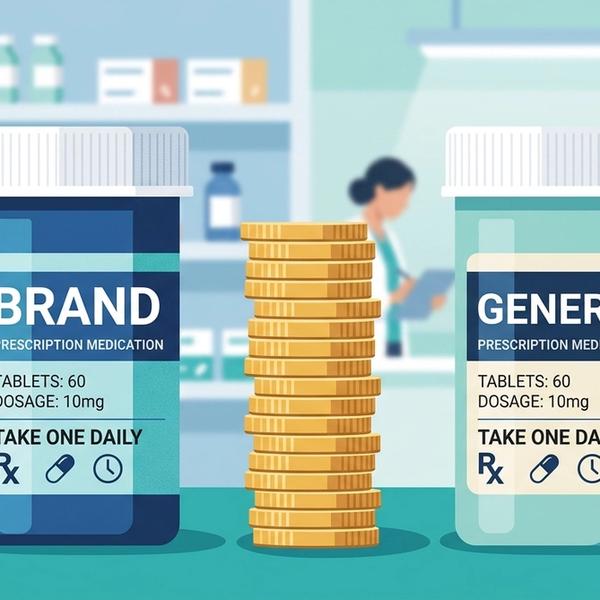
Why brand Lexapro still costs 60 times the generic
Nothing about the drug justifies it. Escitalopram is escitalopram — the FDA requires generic versions to deliver the same active ingredient, in the same amount, absorbed at a comparable rate.
What differs is who's buying. Brand-name Lexapro is now filled almost exclusively by people whose prescription was written with a "dispense as written" instruction, or whose insurance plan quietly kept the brand on formulary. That's a small, captive group, and the price reflects it.
If your bottle says Lexapro and you're paying cash, the single most valuable thing you can do is call your prescriber's office and ask them to remove the DAW notation. That one change usually takes a $600 fill down under $50 at the same pharmacy, same day.
Savings tip: Before you assume you're stuck with the brand, look at your printed prescription label. If it reads "Lexapro" and there's a DAW or "brand medically necessary" flag, that's a prescribing instruction, not a clinical requirement. A message through your prescriber's patient portal is usually enough to change it.
Escitalopram cost by strength: 5 mg, 10 mg, and 20 mg
Escitalopram comes in 5 mg, 10 mg, and 20 mg tablets, plus a 1 mg/mL oral solution. Here's the part that surprises people paying cash: the strengths cost nearly the same.
| Strength | 30 tablets, discount-card cash price | 90 tablets, cash price |
|---|---|---|
| 5 mg | ~$8 – $13 | ~$15 – $28 |
| 10 mg | ~$8 – $12 | ~$14 – $26 |
| 20 mg | ~$9 – $15 | ~$18 – $32 |
| Oral solution, 240 mL | ~$40 – $95 | not typically stocked |
Approximate US cash ranges, September 2026.
Pharmacy pricing is driven far more by the number of tablets than by how much drug is in each one. A 20 mg tablet contains four times the escitalopram of a 5 mg tablet and costs maybe a dollar more.
That opens a legitimate conversation with your prescriber. Escitalopram tablets are scored, and if you take 10 mg daily, a 20 mg tablet split in half gives you two doses at roughly the price of one. Don't do this on your own — the split has to be part of how the prescription is written and dispensed — but it's a standard, entirely above-board request, and many prescribers write it that way for cash-paying patients without being asked twice.
The oral solution is the exception to the "strength barely matters" rule. It costs considerably more per dose than tablets and is generally reserved for people who can't swallow pills or who need doses between the available tablet strengths.
What escitalopram costs at different pharmacies
The related searches under this query are almost all pharmacy names — people want to know whether CVS or Walmart is cheaper. Here's the honest picture.
| Where you fill it | 10 mg, 30 tablets | Notes |
|---|---|---|
| Large chain (CVS, Walgreens) sticker | $46 – $126 | Highest published sticker prices |
| Large chain with a discount card | $8 – $15 | Same pharmacy, different price |
| Walmart / grocery pharmacy | $10 – $20 | Some generic programs price it flat |
| Costco / Sam's Club cash | $8 – $16 | No membership needed to use the pharmacy |
| Amazon Pharmacy cash | ~$9.50 | Retail comparison listed at $125.70 |
| Transparent-pricing online pharmacy | ~$9 – $14 | Published cost-plus markup |
| Cash-pay health network | Varies | Compare against your best local quote |
The real lesson isn't that one chain beats another. It's that the same chain will charge you $126 or $12 for the identical bottle depending on whether a discount code got applied at the register. Pharmacy sticker prices for generics are largely fictional — they exist to be discounted against.
Savings tip: Ask the pharmacist this exact question: "What's your cash price, and is there a lower price with any discount program you accept?" They can usually run both in under a minute. Many pharmacists will not volunteer the second number unless you ask for it.
Why one person pays $19 a tablet and another pays 8 cents
Three things drive almost all of the variation, and none of them are about the medication.
Quantity tier. Escitalopram gets dramatically cheaper per tablet as the count goes up. PharmacyChecker's verified low for generic escitalopram 10 mg is $0.08 per tablet — but that's on a 270-tablet fill. The same pharmacy might charge $0.40 a tablet for 30. Filling 90 or 100 at a time instead of 30 is usually the single biggest lever available to a cash payer.
Which pricing channel the claim runs through. A cash transaction, a discount-card transaction, and an insurance claim are three different price lists at the same counter. This is why a copay can be higher than the cash price — you're comparing a plan's negotiated tier against a rate the pharmacy set independently.
Manufacturer and supply. More than a dozen companies make escitalopram for the US market. When one has a supply interruption, prices at pharmacies sourcing from that manufacturer tick up for a few months. It's a real effect, and it's one reason a price you checked last spring may not hold today.
The 90-day math, with real numbers
Say you take escitalopram 10 mg daily and you're paying cash.
- Filling 30 tablets monthly at $12: $144 a year, plus twelve trips to the pharmacy.
- Filling 90 tablets quarterly at $20: $80 a year, four trips.
- Filling 270 tablets at roughly $0.08 each: about $22 for nine months, one trip.
The savings are real but modest in absolute dollars — this is a cheap drug once you're on the generic. Where 90-day fills genuinely matter is in not missing doses. Escitalopram has a meaningful discontinuation syndrome; running out for three days because you couldn't get to the pharmacy is a worse outcome than paying an extra $60 a year.
Two cautions before you request a large fill. If you've just started escitalopram or your dose is still being adjusted, a 30-day supply is the right call — you don't want 270 tablets of a strength you're about to leave behind. And escitalopram tablets carry a typical shelf life of two to three years, so a nine-month supply is fine, but check the expiration date on the bottle.
How escitalopram compares to other antidepressants on price
If cost is a live factor in what you and your prescriber choose, this entire class is inexpensive as generics. For reference, here's what several of them run through the CanAmerica Plus cash-pay network as of September 2026:
| Medication | CanAmerica Plus cash price |
|---|---|
| Sertraline (generic Zoloft) | $55.99 / 100 capsules |
| Citalopram (generic Celexa) | $55.99 / 100 tablets |
| Fluoxetine (generic Prozac) | $61.99 / 100 capsules |
| Venlafaxine XR (generic Effexor XR) | $54.99 / 100 capsules |
| Duloxetine (generic Cymbalta) | $34.99 / 28 capsules |
| Brand Zoloft | $175.99 / 100 capsules |
| Brand Cymbalta | $71.99 / 28 capsules |
Escitalopram pricing on the CanAmerica Plus network changes with available pack sizes — check the pricing calculator on the escitalopram page for what's currently in stock.
The spread across the whole class is a few dollars a month. Which means cost should almost never be the deciding factor in which antidepressant you take. Tolerability, interactions, your history with a given drug, and your prescriber's clinical read all matter more. Switching antidepressants involves a taper, a ramp-up, and a real possibility that you feel worse before you feel better — not something to do to save $3.
If you've been reading about alternatives, our breakdown of generic sertraline and what it costs covers the same ground for Zoloft.
When the prescription isn't the expensive part
A recurring thread in online discussions about escitalopram cost isn't the drug at all. It's the appointment required to get the refill.
Escitalopram is prescription-only. Every twelve months, most prescribers want a visit before they'll continue writing it, and if you're uninsured that visit can cost more than a year's worth of the medication. Some realistic options:
- Federally qualified health centers use sliding-scale fees based on income. A visit can run $20 to $50 for someone with no insurance, and they can manage ongoing antidepressant prescriptions.
- Telehealth mental health visits for medication management typically run $75 to $120 self-pay, often less for follow-ups than for a first appointment.
- Ask for a longer refill window. If you're stable, some prescribers will write for a year of refills rather than six months. It's worth asking directly.
We've covered what a standard self-pay appointment runs in doctor visit costs without insurance and what ongoing therapy costs without insurance.
The bottom line
Lexapro without insurance costs around $600 a month. Escitalopram — the same molecule, same effect — costs somewhere between $8 and $50 depending entirely on where and how you fill it. If you're paying anything close to the brand price, the problem is almost certainly a prescribing instruction or a pharmacy channel, not the drug.
Two calls fix most of it: one to your prescriber to make sure the script allows the generic, and one to the pharmacy to ask for both the cash price and the discounted price. Then compare that number against a cash-pay network and pick whichever is lowest. And don't change or stop your antidepressant on your own — that conversation belongs with the person who prescribed it.
Frequently asked questions
How much is Lexapro without insurance per month?
Brand-name Lexapro 10 mg runs about $571 to $602 for a 30-day supply at US retail pharmacies as of September 2026, which works out to roughly $19 per tablet. Generic escitalopram at the same strength and quantity averages $46 at sticker price and commonly drops to $8 to $12 with a prescription discount program.
Is generic escitalopram as good as Lexapro?
Yes. The FDA requires generic escitalopram to contain the same active ingredient at the same strength as Lexapro and to demonstrate bioequivalence — comparable absorption into the bloodstream. Inactive fillers, tablet color, and shape can differ between manufacturers, which occasionally matters for people with specific dye sensitivities, but the clinical effect is the same.
Why is Lexapro so expensive without insurance?
Generic escitalopram has been available since 2012, so almost nobody fills the brand anymore. The people who do are typically locked in by a "dispense as written" instruction or an unusual formulary placement, and the brand price no longer has to compete for that small group. Removing the DAW notation from your prescription usually resolves it.
What is the cheapest way to get escitalopram without insurance?
Filling a larger quantity at a transparent-pricing pharmacy is generally cheapest — verified US prices reach about $0.08 per tablet on 270-count fills. Discount cards at major chains, warehouse pharmacy cash prices, and cash-pay health networks all land in a similar $8 to $20 range for a 30-day supply. Compare at least three before you fill.
Does escitalopram cost more at a higher dose?
Barely. A 20 mg tablet typically costs a dollar or two more than a 5 mg tablet for the same quantity, because pharmacy pricing tracks tablet count rather than milligrams. If you take 10 mg daily, ask your prescriber whether writing for scored 20 mg tablets to split is appropriate for you — it can cut the per-dose cost close to half.
Can I buy escitalopram without a prescription?
No. Escitalopram is prescription-only in the United States. Any site offering it without a valid prescription is operating outside US law, and neither the identity nor the quality of what arrives can be verified. If cost of the appointment is the barrier, a federally qualified health center or a self-pay telehealth visit is a legitimate path.
This article is for informational purposes only and does not constitute medical advice. Always consult with a qualified healthcare provider for diagnosis and treatment. Pricing information is current as of the publication date but may change. Verify pricing directly before making purchasing decisions.