Teeth Whitening Cost in 2026: Real Prices & How to Save
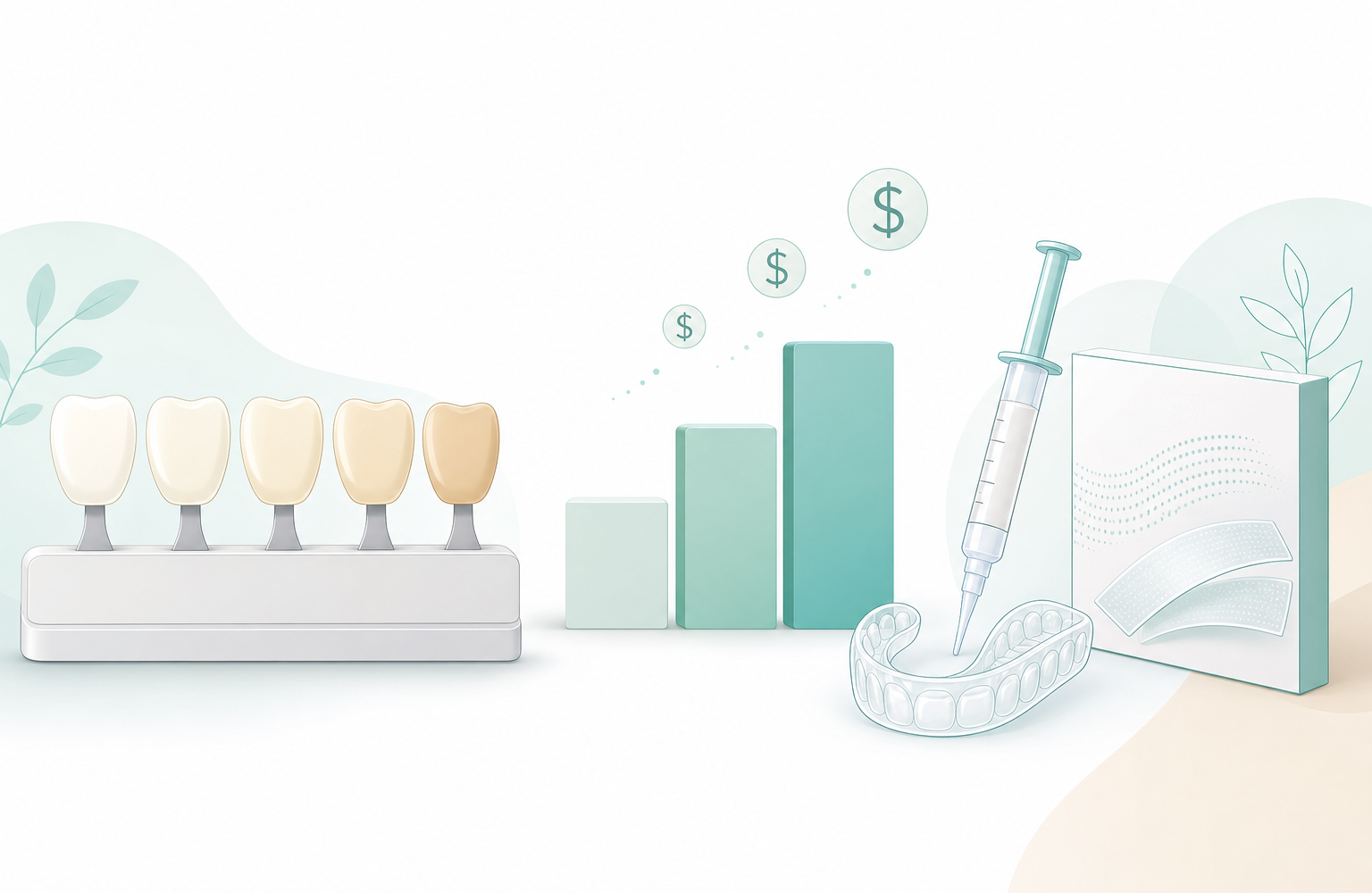
Ask three dental offices what teeth whitening costs and you'll get three answers between $199 and $1,400 — for a procedure that takes about an hour. Nobody quotes you a price over the phone, insurance won't touch it, and the box of strips at Walgreens claims it does the same job for $45.
Some of that price gap is real. Some of it is just what the office in front of you decided to charge. Here's what whitening actually costs in the US right now, broken down by method, by brand-name system, and by what you get for the money — plus the part most pricing guides skip, which is whether your particular stain can be bleached at all.
At a glance
- Drugstore whitening strips run $20–$70; dentist-supervised custom trays run $200–$600; in-office light-activated whitening runs $350–$1,000 per session
- Teeth whitening is classified as cosmetic, so dental insurance essentially never covers it — this is a cash-pay purchase from the start
- In-office whitening costs roughly $100 per shade of improvement; custom take-home trays land closer to $55 per shade
- Whitening does nothing for crowns, veneers, or fillings, and very little for gray tetracycline staining — spending $900 on the wrong problem is the most expensive mistake here
- A $75–$200 cleaning removes surface stain from coffee, tobacco, iron supplements, and chlorhexidine rinse, which is sometimes the only thing you needed
How much does teeth whitening cost in 2026?
Five tiers, and the jump between them is mostly about peroxide concentration and who is supervising.
| Method | Typical US cost | Shades gained | Time to result |
|---|---|---|---|
| Whitening toothpaste | $5–$12 per tube | 0–1 (surface only) | 4–8 weeks |
| Drugstore strips, pens, LED kits | $20–$70 | 2–4 | 10–21 days |
| Premium at-home LED kits | $80–$150 | 2–4 | 2–4 weeks |
| Dentist custom trays + gel | $200–$600 | 4–8 | 1–3 weeks |
| In-office light-activated | $350–$1,000 per session | 3–8 | One visit |
| Extended deep-bleaching protocols | $700–$1,500 | 8–16 | 2–8 weeks |
Those are national ranges for 2026. Geography moves them more than anything else: the same Philips Zoom appointment is commonly $450 in Oklahoma City and $900 in Manhattan, and the gel, light, and chairtime are identical.
What you're buying at the top of the table is peroxide strength plus someone watching your gums. Drugstore strips sit around 6–10% hydrogen peroxide. Dentist-dispensed take-home gel is usually 10–22% carbamide peroxide. In-office systems run 25–40% hydrogen peroxide, which is strong enough that your lips, gums, and tongue have to be physically isolated before it goes on.
What a shade of whiteness actually costs
Dental offices quote the procedure. They rarely quote the result. Running the two together is where the value shows up.
| Option | Typical price | Realistic shade gain | Cost per shade |
|---|---|---|---|
| Crest 3D Whitestrips course | $45 | 3 | ~$15 |
| At-home LED kit | $110 | 3 | ~$37 |
| Dentist custom trays | $350 | 6 | ~$58 |
| In-office single session | $650 | 6 | ~$108 |
| Deep-bleaching protocol | $1,100 | 10 | ~$110 |
Strips win on paper. They lose on evenness and on reach — they don't cover canines and molars well, and they can leave the gumline darker than the middle of the tooth. Custom trays are the sweet spot for most people: the gel is stronger, the trays touch every surface, and you keep the trays for years.
In-office whitening is not better whitening. It's faster whitening, with a professional managing sensitivity. If you're getting married in nine days, that's worth $650. If you have three months, it generally isn't.
Professional teeth whitening cost by system
When an office quotes you a price, it's quoting a specific branded product. Knowing which one tells you whether the number is fair.
| System | What it is | Typical cost |
|---|---|---|
| Philips Zoom WhiteSpeed | In-office, 25% HP, blue LED, 3–4 cycles | $400–$1,000 |
| Opalescence Boost | In-office, 40% HP, chemically activated, no light | $350–$800 |
| KöR Deep Bleaching | Refrigerated gel, in-office visit plus weeks of nightly trays | $700–$1,500 |
| Opalescence PF take-home | Dentist-dispensed trays, 10–35% CP | $200–$500 |
| GLO Science in-office | Heat-and-light mouthpiece, shorter cycles | $350–$600 |
| Diode "laser" whitening | Marketing term for light-activated, varies by office | $600–$1,500 |
Two things worth knowing before you pay a premium. "Laser whitening" is not a distinct technology — it's a light source accelerating the same peroxide, and the published evidence for light activation adding shades is thin. And Opalescence Boost deliberately uses no light at all, which is why it's often the cheapest in-office option on the menu without being the weakest.
Savings tip: Ask the office for the price of the take-home tray kit by itself, not bundled into a treatment plan. Then ask what a replacement gel syringe costs. Trays are a one-time $200–$450; refill syringes are $20–$60 and last a couple of touch-up cycles. That's the cheapest path to a maintained result in dentistry.
The five-year number nobody quotes you
Whitening fades. Coffee, tea, red wine, tomato sauce, curry, and tobacco all put the color back, usually within 6–24 months. So the honest comparison isn't one appointment against one box of strips — it's five years of keeping the result.
| Approach | Year 1 | Years 2–5 | 5-year total |
|---|---|---|---|
| Drugstore strips, two courses a year | $90 | $360 | ~$450 |
| Custom trays + two gel refills a year | $350 | $280 | ~$630 |
| One in-office session, then tray touch-ups | $900 | $280 | ~$1,180 |
| In-office session every year | $650 | $2,600 | ~$3,250 |
The last row is what a lot of people drift into by default. It's roughly seven times the cost of the second row for a result that isn't seven times whiter.
Before you spend anything: can your stain even be bleached?
This is the question that decides whether whitening is a $350 win or a $900 write-off. Peroxide lifts organic stain out of enamel and dentin. It does not change the color of ceramic, composite, or metal, and it struggles badly with discoloration that was built into the tooth while it formed.
| Type of discoloration | Cause | Does whitening work? |
|---|---|---|
| Extrinsic surface stain | Coffee, tea, wine, tobacco, iron supplements, chlorhexidine rinse | Yes — often a cleaning alone is enough |
| Age-related yellowing | Enamel thinning, dentin showing through | Yes, usually 4–8 shades |
| Mild fluorosis | Excess fluoride during development | Partially; white spots may stand out more |
| Tetracycline banding | Tetracycline-class antibiotics during tooth development | Poorly — months of extended bleaching at best |
| Trauma-darkened single tooth | Internal bleeding or dead pulp | No — needs internal bleaching or a crown |
| Crowns, veneers, white fillings | Not enamel | No, ever |
That last row catches people constantly. If you have a composite filling or a crown on a front tooth, whitening the teeth around it makes it stand out, and matching it afterward means replacing the restoration — $300–$600 for bonding, $900–$2,500 per tooth for a veneer. Ask which of your front teeth have restorations before you book anything.
When your medication is the reason your teeth changed color
A fair number of people searching for whitening prices are actually dealing with drug-related discoloration, and the fix — and the cost — is completely different depending on which kind they have.
The tetracycline family is the well-documented one. Tetracycline, doxycycline, and minocycline bind to calcium in teeth that are still forming, which is why they're generally avoided from the second trimester of pregnancy through about age eight. The result is gray, brown, or blue-gray banding locked inside the tooth structure. Bleaching it is slow and incomplete. Extended protocols like KöR sometimes produce real improvement over three to six months, and at $1,000–$1,500 that's a reasonable thing to try before considering veneers — but it should be presented to you as a maybe, not a guarantee.
Minocycline is the exception that catches adults off guard: it has been reported to darken fully formed teeth in adults on long-term acne or rosacea therapy, usually as a blue-gray cast. If that's what happened, talk to the prescriber about the drug before you talk to anyone about whitening.
Then there's the staining that looks alarming and washes off. Chlorhexidine gluconate rinse, the prescription mouthwash used after periodontal treatment, leaves a brown film on enamel within a couple of weeks of daily use. Liquid iron supplements leave black stain. Both are extrinsic. Both come off with a professional cleaning and polish. Neither needs peroxide.
Early-childhood amoxicillin exposure has also been associated with enamel defects in some studies, which can read as patchy discoloration rather than uniform yellowing — another pattern that responds to bleaching unpredictably.
And a quieter mechanism: anything that dries your mouth out accelerates staining, because saliva is what rinses chromogens off your teeth all day. Antihistamines, several antidepressants, diuretics, and some blood pressure medications all do this. If your teeth started dulling after a medication change, the stain may be new and extrinsic — which is the cheap kind to fix.
What moves the price up or down
- Where you live. Metro cost of living is the single biggest variable. A 40% swing between a major coastal city and a mid-size inland market is normal for the identical system.
- Stain severity. Deep or uneven discoloration means more cycles, or a protocol that spans weeks instead of an hour.
- Sensitivity. Desensitizing gel, lower-concentration passes, and extra appointments all add cost. Sensitivity-managed protocols commonly run $250–$600.
- Whether a cleaning is required first. Most offices won't whiten over plaque, and reasonably so. Budget $75–$200 for the cleaning if you're overdue.
- Bundling. Whitening is frequently discounted — or included — when it's attached to orthodontic treatment or a larger cosmetic plan.
- Shade goal. Going from B1 to the brightest bleached shades takes disproportionately more product than the first few shades did.
Where whitening gets expensive by going wrong
Mall kiosks, tanning salons, and spas sell whitening sessions for $75–$150. In many states a non-dentist legally cannot apply high-concentration peroxide to your teeth, so what you're buying is a weak gel you apply yourself under a light, with nobody isolating your gums. Cheap, and often a repeat purchase within weeks.
Charcoal toothpaste is the other money pit. It's abrasive, there's no good evidence it whitens beyond scrubbing off surface film, and the ADA has not granted it a Seal of Acceptance. Abrade enough enamel and the dentin underneath shows through more — the tooth gets yellower, permanently.
Sensitivity is the cost people forget to price. A third or more of people get zingers during whitening. Brushing with a potassium nitrate toothpaste for two weeks beforehand, and taking rest days between sessions, prevents most of it for about $8. Pushing through aggressively instead can mean abandoning a $350 kit halfway.
How to pay less for teeth whitening
Start by asking what you're actually treating. If the stain is extrinsic, a cleaning at $75–$200 may get you most of the way there — see our breakdown of teeth cleaning cost without insurance for what a prophy should run in cash. Pay for whitening only after you know the surface is clean and what's left is genuinely in the tooth.
Dental school and dental hygiene school clinics are the biggest single lever. Supervised student clinics commonly price whitening 30–60% below private practice, and there are around 70 accredited dental schools in the US plus several hundred hygiene programs. Longer appointments, meaningfully lower price.
Buy the trays once and the gel forever. The custom trays are the expensive part and they last years. After that you're paying $20–$60 per refill syringe, and most offices will sell you refills without a new exam.
Ask for a written estimate with the system name on it, then call two more offices with that name. Whitening is one of the few dental services where you can price-shop a genuinely identical product, because Zoom is Zoom and Opalescence Boost is Opalescence Boost.
And protect the result cheaply: drink coffee and tea through a straw where you can, rinse with water after staining food and drink, and wait 30 minutes before brushing so you're not scrubbing softened enamel.
Worth asking: If a front tooth is darker than its neighbors because of old trauma, external bleaching will never even it out. Internal bleaching through the back of that single tooth runs $300–$700 and is the far cheaper answer than whitening everything and then crowning the one that didn't move.
The bottom line
Teeth whitening cost in 2026 realistically means $45 for strips, $200–$600 for dentist-supervised custom trays, or $350–$1,000 for an in-office session — and trays deliver the best result per dollar for most people. The spending that goes wrong is almost always spending on the wrong diagnosis: bleaching extrinsic stain that a cleaning would have removed, or bleaching intrinsic banding that peroxide can't reach.
Get a straight answer on which kind of discoloration you have and which of your front teeth carry restorations. Then price the specific system by name across a few offices, and look at a dental school clinic before you accept a private-practice quote. Since no insurance plan is covering any of this, every dollar saved is yours.
For related self-pay dental pricing, see our breakdowns of dental crown cost without insurance, cavity filling cost without insurance, and Invisalign cost without insurance.
Frequently asked questions
Is $500 teeth whitening worth it?
For an in-office session in a mid-to-high cost-of-living market, $500 is a fair price and buys 3–8 shades in about an hour under supervision. Whether it's worth it depends on your timeline. If you aren't in a hurry, a $350 custom tray kit typically reaches the same shade over two to three weeks and leaves you with reusable trays.
How much is a full set of teeth whitening?
The prices quoted here are for a full arch or both arches, not per tooth — whitening is priced per treatment. Note that most systems only treat the teeth visible when you smile, usually the front eight to ten per arch, so "full set" doesn't normally include molars.
Can yellow teeth be white again?
Usually, if the yellowing is from age or surface stain. Enamel thins over time and lets the naturally yellower dentin show through, and peroxide lightens that dentin effectively — 4–8 shades is a realistic expectation. Gray discoloration behaves very differently and responds much less.
Do teeth turn yellow again after whitening?
Yes. In-office results commonly hold 6 months to 2 years, take-home tray results about a year with touch-ups, and drugstore strips a few weeks to a few months. Coffee, tea, red wine, and tobacco shorten all of those. Keeping custom trays and refilling the gel is the cheapest way to maintain a shade long term.
Is there a downside to teeth whitening?
Tooth sensitivity and temporary gum irritation are the common ones, and both usually resolve within a few days. Whitening won't change crowns, veneers, or fillings, so existing dental work can end up mismatched. Overusing abrasive whitening products can also wear enamel, which makes teeth look more yellow over time rather than less.
Does dental insurance cover teeth whitening?
No. Whitening is classified as a cosmetic procedure, so dental plans essentially never pay for it, including plans with generous cosmetic language. Some FSA and HSA accounts also exclude it for the same reason. Treat it as an out-of-pocket purchase and shop it accordingly.
This article is for informational purposes only and does not constitute medical advice. Always consult with a qualified healthcare provider for diagnosis and treatment. Pricing information is current as of the publication date but may change. Verify pricing directly before making purchasing decisions.