Cavity Filling Cost Without Insurance 2026: Real Prices
Cavity Filling Cost Without Insurance 2026: Real Prices
You went in for a cleaning, the hygienist took bitewings, and now there's a treatment plan on the counter with a number you weren't ready for. One cavity. Two surfaces. Four hundred dollars.
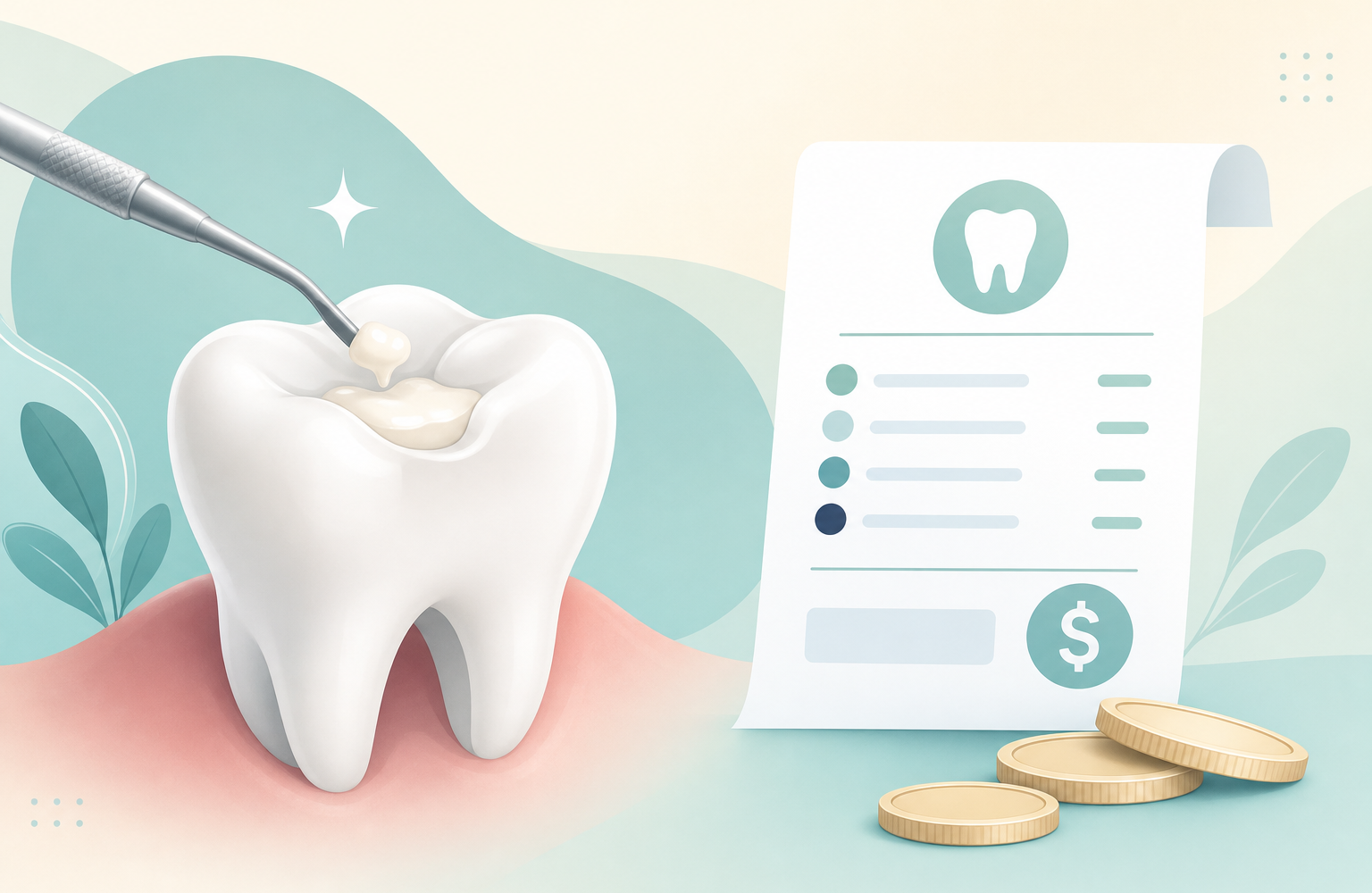
The cavity filling cost without insurance in the US usually lands somewhere between $150 and $450 per tooth — but the published "averages" you'll find online range from $100 to $2,800, which is close to useless when you're trying to figure out whether the quote in your hand is fair. The spread exists because a one-surface silver filling on a back molar and a four-surface tooth-colored restoration on a front tooth are billed as completely different procedures. Once you know which one you're being quoted for, the price stops being mysterious.
At a glance
- Most single fillings without insurance run $150-$450 per tooth; Aspen Dental reports a $259 average with a $171-$374 range, and Humana cites $199-$333
- Amalgam (silver) fillings cost roughly 25-40% less than composite (tooth-colored), but many practices no longer offer amalgam at all
- Price climbs with every tooth surface filled — a two-surface composite typically costs $60-$120 more than a one-surface
- Your first visit bill usually includes an exam and X-rays on top of the filling, adding $75-$250
- Dental schools and federally qualified health centers routinely charge 40-70% below private practice rates
- Waiting a year can turn a $250 filling into a $1,400-$2,500 root canal and crown
How much does a cavity filling cost without insurance?
Here's what the major sources currently publish for a single filling, self-pay:
| Source | Quoted cost per filling (no insurance) |
|---|---|
| Cigna | From $160 per tooth on average |
| Humana | $199-$333 |
| Aspen Dental | $259 average, $171-$374 range |
| Delta Dental | $110-$455 for amalgam, by surface count |
| GoodRx | $100 (amalgam) to about $1,050 (porcelain) |
| Aflac | $108-$1,774 per tooth |
Notice that four of those six sources are dental insurance carriers. That shapes what they emphasize. The practical read: for a routine one- or two-surface filling at a general dentist, budget $150-$450. Above $500 usually means a large multi-surface restoration, an indirect inlay or onlay, or a high-cost metro market. Below $120 usually means amalgam, a community clinic, or a dental school.
Cavity filling cost by material
The material your dentist uses is the single biggest driver of price after surface count.
| Material | Typical cost per tooth (no insurance) | Typical lifespan | Notes |
|---|---|---|---|
| Amalgam (silver) | $100-$300 | 10-15 years | Cheapest and very durable, but visibly metallic; many offices have phased it out |
| Composite resin (tooth-colored) | $150-$450 | 5-10 years | The default in most US practices today |
| Glass ionomer | $100-$300 | ~5 years | Releases fluoride; often used near the gumline or for children |
| Porcelain / ceramic inlay | $500-$1,500 | 15+ years | Lab-fabricated, usually two visits, priced like a partial crown |
| Gold inlay or onlay | $700-$2,500 | 20+ years | Longest-lasting, rarely chosen on a cash budget |
If cost is your constraint, ask directly whether amalgam is an option for a back tooth. Some offices will say no because they've stopped stocking it. Others will quote you $120 instead of $290 for the same tooth. It's worth the question, and the FDA's 2020 guidance recommends avoiding amalgam for certain higher-risk groups — including pregnant people and children under six — so your dentist may have a clinical reason to steer you elsewhere.
Why surface count changes the price — and the codes to ask for
Every filling gets billed under a five-character CDT code, and the code tells you exactly what you're paying for. Asking for the codes on your treatment plan is the fastest way to compare two quotes honestly.
| CDT code | Procedure | Surfaces | Typical cash price |
|---|---|---|---|
| D2140 | Amalgam, permanent tooth | 1 | $110-$200 |
| D2150 | Amalgam, permanent tooth | 2 | $140-$260 |
| D2160 | Amalgam, permanent tooth | 3 | $170-$320 |
| D2391 | Composite, posterior | 1 | $150-$300 |
| D2392 | Composite, posterior | 2 | $200-$380 |
| D2393 | Composite, posterior | 3 | $250-$450 |
| D2330 | Composite, anterior | 1 | $140-$280 |
| D2332 | Composite, anterior | 3 | $220-$420 |
A "surface" is a face of the tooth — top, cheek side, tongue side, and the two sides that touch neighboring teeth. A cavity that has spread across three surfaces takes longer, uses more material, and is harder to get right, so it's coded and priced differently.
Two offices quoting "$300 for a filling" can mean very different things. If one is quoting D2392 and the other D2393, you're not comparing the same procedure.
Savings tip: Ask the front desk to print your treatment plan with CDT codes and self-pay prices before you agree to anything. Then call two other practices and read them the codes. Most will quote you over the phone, and price differences of $100-$200 per tooth within the same city are common.
The bill is bigger than the filling
This is where budgets break. You plan for a $250 filling and the invoice says $520, because a filling almost never gets billed alone on a first visit.
| Line item | CDT code | Typical cash price |
|---|---|---|
| Comprehensive exam (new patient) | D0150 | $75-$200 |
| Problem-focused exam | D0140 | $50-$150 |
| Four bitewing X-rays | D0274 | $50-$120 |
| Single periapical X-ray | D0220 | $25-$50 |
| Full mouth series | D0210 | $100-$250 |
| Local anesthetic | Usually bundled | $0-$60 |
Add it up and a single-filling visit with a new-patient exam and bitewings realistically runs $300-$650 all in. Many practices advertise a $59-$99 new patient special that bundles the exam and X-rays — if you're paying cash and starting somewhere new, that offer is real money. If a cleaning is also on the plan, our breakdown of teeth cleaning costs without insurance covers what that line item should look like.
Nitrous oxide, if you want it, is another $50-$150 and is almost never covered even when you do have insurance.
What waiting actually costs
The most expensive decision here isn't which material you pick. It's postponing.
Decay doesn't stall. Once it breaches the enamel and reaches dentin, it moves faster, and the treatment escalates in a fairly predictable way:
| Where the decay is | Likely treatment | Typical cash cost |
|---|---|---|
| Enamel only | Filling, 1-2 surfaces | $150-$380 |
| Into dentin | Filling, 3+ surfaces, or onlay | $250-$900 |
| Near the pulp | Root canal + crown | $1,400-$2,500 |
| Tooth not restorable | Extraction | $150-$400 |
| Replacing the tooth | Implant + crown | $3,000-$5,000 |
Extraction pricing follows similar logic to wisdom teeth removal without insurance, where surgical complexity drives the number more than the tooth itself does.
A $250 filling you skip this spring can be a $1,900 root canal and crown next spring. That's not a scare tactic — it's the same tooth, twelve months apart, and it's the arithmetic that makes a filling one of the better uses of cash in dentistry.
If you genuinely can't pay right now, tell your dentist that. Many will place an interim therapeutic restoration (D2940, typically $60-$150) to seal the tooth and buy you a few months without letting the decay run.
When a cavity becomes an infection, the prescriptions start
Untreated decay that reaches the pulp can turn into an abscess, and that adds a prescription to the bill on top of emergency dental work. Dentists commonly prescribe amoxicillin first, or Augmentin when the infection is more established. If you're allergic to penicillin, clindamycin is a standard alternative, and metronidazole is sometimes added when anaerobic bacteria are involved.
None of these are expensive drugs, but US retail cash prices at a chain pharmacy are frequently several times what the same generic costs through a cash-pay network. As of August 2026, CanAmerica Plus lists amoxicillin 500 mg at $92.99 for 100 tablets and metronidazole 500 mg at $54.99 for 100 tablets — quantities well beyond a single dental course, which matters if you have a recurring need.
Antibiotics don't fix a cavity. They buy time and control an infection so the tooth can be treated. Skipping the dental work after the swelling goes down is how people end up back in the same chair three months later, paying for an extraction.
Where to get a cheaper filling without insurance
The insurance carriers ranking for this search have one answer: buy dental insurance. Here are the options that actually reduce what you hand over at the desk.
Dental schools. Every accredited US dental school runs a clinic where supervised students treat the public at 40-70% below private practice fees. A composite filling that's $300 down the street is often $80-$150. The tradeoff is time — appointments run two to three hours and you may need more visits. The American Dental Association maintains a directory of accredited programs.
Federally qualified health centers. FQHCs and community health centers with dental services charge on a sliding scale tied to household income. Some patients pay a nominal $25-$50 visit fee. HRSA's find-a-health-center tool lists them by ZIP code. Availability varies enormously by county, and wait times can be long, so call early.
In-office membership plans. A growing number of practices sell their own annual plan, usually $200-$400 a year, that includes two cleanings and exams plus 15-25% off restorative work. If you need one filling and a cleaning, the math often works out in the first year. Read whether the discount applies to the filling itself, not just hygiene.
Ask for the cash or prompt-pay discount. This is underused. Practices lose 4-8% of every insurance claim to processing and write-offs, and many will quietly take 5-15% off for a patient paying in full on the day of service. You have to ask, and you have to ask before treatment, not at checkout.
Get the treatment plan in writing, then shop it. Decay doesn't usually need same-week treatment unless you're in pain. Taking three days to price the coded plan at two other offices is normal and no competent practice will be offended.
Third-party financing, carefully. CareCredit and similar products offer promotional no-interest periods, but deferred interest is retroactive if you don't clear the balance in time. In-house payment plans through the practice are usually the cleaner option when they exist.
Is dental insurance worth buying just for a filling?
Probably not, and it's worth running the numbers before you sign up mid-treatment.
A standalone individual dental plan typically costs $25-$60 a month. Most impose a 6-12 month waiting period on basic restorative work, cover fillings at 70-80% after a $50-$100 deductible, and cap annual benefits around $1,000-$1,500.
So for a single $300 filling: you'd pay $300-$720 in premiums over the waiting period, then a deductible, then your 20-30% share. You come out behind. Insurance earns its keep when you're facing several years of ongoing work or a family with predictable needs — not when you're solving one tooth.
The bottom line
Budget $150-$450 for a routine filling without insurance, and $300-$650 for the whole first visit once the exam and X-rays are counted. Get your treatment plan printed with CDT codes, call two other offices with those codes, and ask each one for their cash price. If the number is still out of reach, a dental school or an FQHC will usually cut it by half or more — and an interim restoration beats leaving the tooth open while you save up.
Frequently asked questions
What is the cheapest way to fill a cavity?
A dental school clinic is almost always the lowest-cost route, often $80-$150 for a composite filling versus $300 at a private practice. Federally qualified health centers with sliding-scale fees can be cheaper still if you qualify by income. At a regular office, choosing amalgam over composite on a back tooth and asking for the prompt-pay cash discount are the two levers that move the price most.
How much are cavity fillings with no insurance?
Most single fillings run $150-$450 per tooth. Amalgam sits at the low end ($100-$300), composite in the middle ($150-$450), and porcelain or gold inlays well above that ($500-$2,500). The number of tooth surfaces involved can swing the price by $100-$200 on its own.
Is $250 for a filling expensive?
No — $250 is squarely in the normal range for a one- or two-surface composite filling in most US markets. It would be on the high side for a one-surface amalgam and a bargain for a three-surface composite on a molar. Ask which CDT code you're being quoted, then compare against that code rather than against a generic average.
Can I wait six months to fill a cavity?
Sometimes, but it's a gamble with a bad payout. A small enamel lesion may progress slowly; decay that's already into dentin can reach the pulp in a matter of months. If it does, you're looking at a root canal and crown at $1,400-$2,500 instead of a filling at $250. If money is the obstacle, ask your dentist about a temporary sealing restoration to hold the tooth while you arrange payment.
Does the price change for a front tooth versus a molar?
Yes. Anterior (front) fillings are billed under different codes than posterior (back) ones and are often slightly cheaper per surface, but front teeth carry a cosmetic requirement — the shade has to match — which can add chair time. Molars tend to need more surfaces filled, which is why back-tooth fillings usually cost more overall.
This article is for informational purposes only and does not constitute medical advice. Always consult with a qualified healthcare provider for diagnosis and treatment. Pricing information is current as of the publication date but may change. Verify pricing directly before making purchasing decisions.