Ultrasound Cost Without Insurance 2026: Real Prices
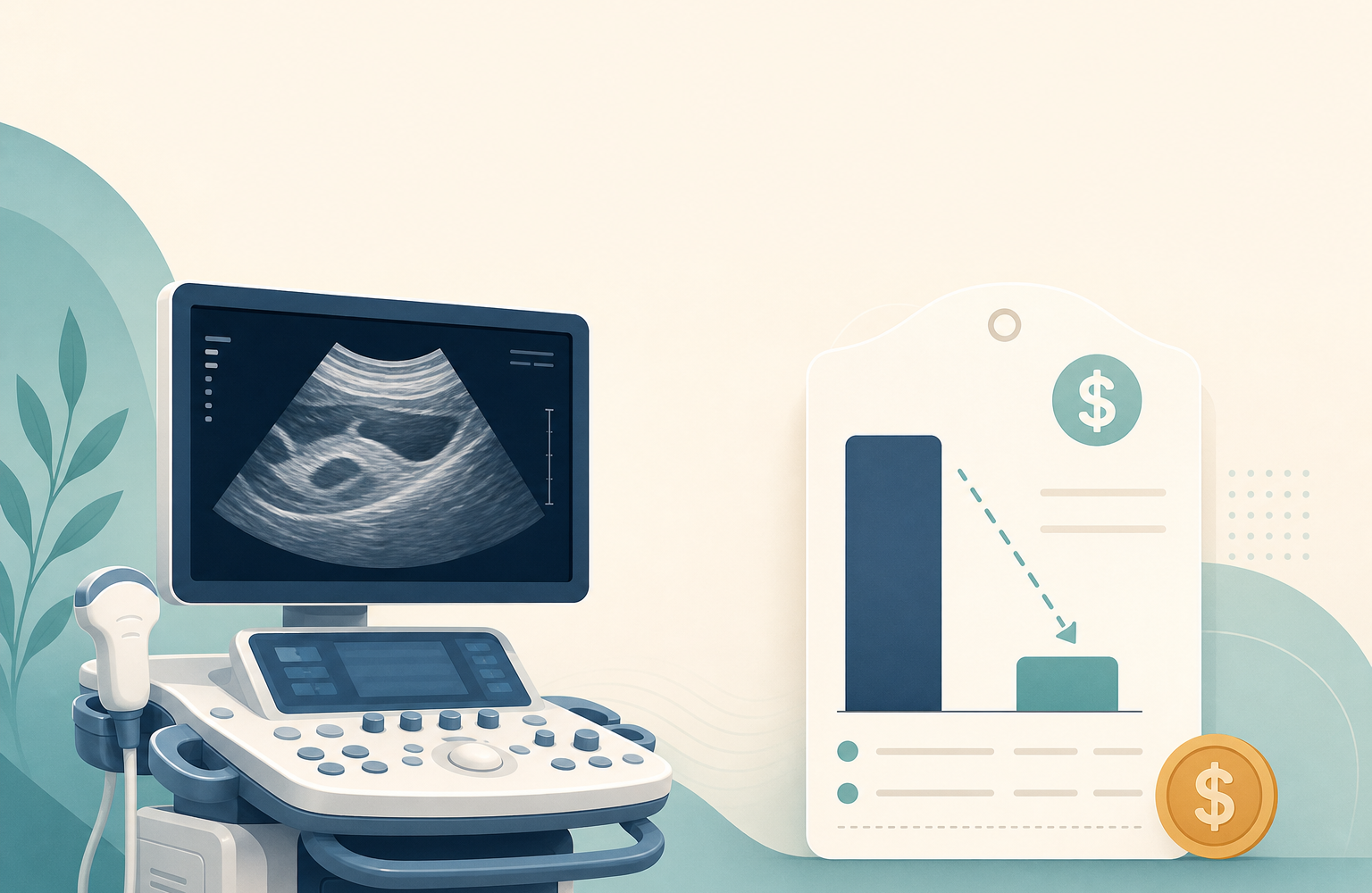
You call the hospital to ask what an ultrasound costs. They tell you they can't quote it until it's billed. You go anyway, because your doctor ordered it, and six weeks later you're holding a bill for $840.
The imaging center in the same zip code would have done it for $180, cash, quoted over the phone in about ninety seconds. Same probe, same gel, same board-certified radiologist reading the images. Ultrasound is the cheapest scan in diagnostic imaging — no radiation, no magnet, no contrast dye — and it's still one of the easiest places in American healthcare to overpay by 400%.
At a glance
- Ultrasound cost without insurance typically runs $150 to $500 at a freestanding imaging center and $400 to $1,200+ at a hospital outpatient department
- The national self-pay average for a single body area is about $400, but competitive metro markets come in far lower — the Dallas median is around $164
- A "limited" study is a different billing code than a "complete" one and often costs 30% to 50% less; almost nobody tells patients this
- You're legally entitled to a written good-faith estimate before the scan under the No Surprises Act
- Ask whether the quote includes the radiologist's interpretation, or you'll get a second bill weeks later
How much is an ultrasound without insurance?
Self-pay ultrasound prices in the US land between $100 and $1,000 for most standard studies, with a national average around $400 for a single body area. A handful of specialized studies — a full echocardiogram, a detailed fetal anatomy scan — climb past that.
But the average hides the thing that actually determines your bill:
| Where you get it | Typical self-pay price | What's driving it |
|---|---|---|
| Freestanding imaging center | $150 – $500 | Low overhead, competes on price, usually quotes a bundled rate |
| Independent OB/GYN or specialist office | $150 – $450 | In-house machine, often bundled into the visit |
| Hospital outpatient department | $400 – $1,200+ | Facility fee stacked on top, radiologist billed separately |
| Emergency room | $1,000 – $3,000+ | ER facility pricing applies to everything performed there |
The spread is not about image quality. Ultrasound equipment is comparatively cheap — a good cart-based system runs $30,000 to $150,000, against $2 million for a 3T MRI magnet. That's why the price should be low, and why the hospital number is so hard to justify.
Geography moves it too, though less than facility type. An abdominal ultrasound averages roughly $228 in Iowa and $325 in Alaska. In Dallas–Fort Worth, where a dozen imaging centers compete, the market median is around $164 and self-pay quotes commonly run $155 to $283.
Ultrasound cost by type in 2026
Here's the part every other cost guide leaves out: the CPT code. It's the five-digit billing code for your specific study, and it's the only way to compare two facilities honestly. "How much is a pelvic ultrasound?" is a question two centers can answer accurately with wildly different numbers, because they're quoting different codes.
Ask your doctor's office for the code on the order. They have it. It takes them ten seconds.
| Study | CPT code | Typical self-pay range |
|---|---|---|
| Abdomen, complete | 76700 | $150 – $650 |
| Abdomen, limited (e.g. gallbladder only) | 76705 | $95 – $350 |
| Kidneys / retroperitoneal, complete | 76770 | $150 – $500 |
| Pelvic (non-OB), complete | 76856 | $125 – $400 |
| Pelvic, limited | 76857 | $50 – $250 |
| Transvaginal (non-OB) | 76830 | $100 – $350 |
| Breast, one side, complete | 76641 | $100 – $500 |
| Thyroid / soft tissue neck | 76536 | $100 – $600 |
| Carotid duplex, complete | 93880 | $250 – $800 |
| Venous duplex, leg, DVT rule-out | 93970 / 93971 | $250 – $1,100 |
| Scrotal | 76870 | $150 – $450 |
| OB, first trimester (under 14 weeks) | 76801 | $90 – $400 |
| OB, second/third trimester | 76805 | $150 – $500 |
| OB, detailed fetal anatomy | 76811 | $300 – $950 |
| OB, limited "quick look" | 76815 | $75 – $250 |
| Echocardiogram, complete with Doppler | 93306 | $400 – $3,000 |
| Ultrasound-guided biopsy | varies | $100 – $1,000 |
Low end of each range is a competitive freestanding center quoting a cash rate. High end is a hospital outpatient department, or a rural market with one provider and no reason to discount.
"Complete" versus "limited" — the cheaper code nobody mentions
Look at 76700 and 76705 in that table. Same organ system. Roughly half the price.
A complete abdominal ultrasound images the liver, gallbladder, bile ducts, pancreas, spleen, kidneys, and the major abdominal vessels. A limited study looks at one thing — usually the gallbladder, if that's what your doctor is actually worried about. The same complete/limited split exists for pelvic scans (76856 vs. 76857), kidney scans (76770 vs. 76775), breast (76641 vs. 76642), and carotids (93880 vs. 93882).
If your doctor ordered a complete study out of habit and the clinical question is narrow, it's a fair thing to raise: "Given what you're looking for, would a limited study answer it?"
Sometimes the answer is no, and that's a real clinical reason — a complete abdominal scan can catch something incidental that matters. But sometimes the order was a default, and asking saves you $200. Your doctor decides. You're allowed to ask the question.
Savings tip: Take the referral to the facility you choose. A doctor's order is not a binding assignment to a particular building. Ask the office to fax or send the order to the accredited imaging center you picked. They do this daily and it costs them nothing.
Why a hospital charges $840 for a $180 scan
Two mechanisms, and both are invisible on the bill unless you know to look.
The first is the facility fee. Hospital outpatient departments are licensed as part of the hospital, which carries overhead a standalone clinic doesn't — 24-hour staffing, trauma readiness, uncompensated emergency care. That cost gets spread across every service the hospital delivers, including your fifteen-minute thyroid scan, which required none of it.
The second is provider-based billing, and it catches almost everyone. Hospitals have spent two decades acquiring independent physician practices and imaging clinics. The building keeps its name, its staff, its parking lot. What changes is the billing classification: it's now a hospital outpatient department, so it can charge the hospital facility fee. Nothing about the storefront tells you this happened.
One question resolves it: "Is this location billed as a hospital outpatient department or as a freestanding facility?" Front desk staff generally know, and answer honestly.
The second bill — and the sentence that prevents it
You call, get quoted $200, pay it, and feel like you handled it. Seven weeks later an envelope arrives from a radiology group you've never heard of asking for another $95.
That's the professional component. An imaging bill has two parts: the technical component covers the machine, the sonographer, and the room. The professional component covers the radiologist who reads your images and writes the report. Some facilities bundle them into one global rate. Many quote you only the technical side and let the radiology group bill you separately.
The fix is one sentence on the phone:
"Is that a global rate that includes the radiologist's interpretation, or will I receive a separate bill from a reading physician?"
Ask for the answer by email. If a facility won't put a global number in writing before you show up, that tells you something useful about how the billing will go afterward.
Your right to a good-faith estimate
Since January 2022, the No Surprises Act has required providers to give uninsured and self-pay patients a written good-faith estimate of expected charges before a scheduled service. They're required to tell you the right exists. Most don't volunteer it.
The teeth are in the dispute provision: if your final bill lands $400 or more above the good-faith estimate, you can challenge it through the federal patient–provider dispute resolution process. Facilities know this, which is part of why requesting the estimate in writing tends to produce a more careful quote in the first place.
You can also look prices up without calling anyone. Federal price transparency rules require hospitals to publish a machine-readable file of standard charges — including discounted cash prices — plus a consumer-facing display of common shoppable services. Search the hospital's name plus "price transparency" or "standard charges," find your CPT code, and you'll often have the cash price before your first phone call.
How to find the cheapest ultrasound near you
Sequence matters here.
- Get the CPT code and the words "complete" or "limited" from your doctor's office. Everything downstream depends on this.
- List the accredited facilities within a reasonable drive. The American College of Radiology and the American Institute of Ultrasound in Medicine both publish searchable accreditation directories. Widen the radius — a thirty-minute drive to save $400 is a good use of an afternoon.
- Call each one with the same three questions. What's your self-pay rate for CPT [code]? Does that include the radiologist's read? What's your prompt-pay discount?
- Ask for the discount in plain words. Something like: "I'm paying cash at the time of service. What's your best self-pay rate?" Many centers take 20% to 40% off for payment at time of service. It is almost never advertised. It is frequently available.
- Request the good-faith estimate in writing from the facility you choose.
- If the bill has already arrived, ask for an itemized statement and check it against what you actually had done. Duplicate charges and upcoded studies are common enough to be worth twenty minutes. Hospital charity care policies — required of nonprofit hospitals under section 501(r) — can often be applied retroactively, and eligibility thresholds are more generous than most people assume.
Three calls usually surface a $200 spread. Five sometimes surface a $600 one.
Pregnancy ultrasounds without insurance
Prenatal scans are the single biggest slice of ultrasound searches, and they follow slightly different rules.
A first-trimester dating scan (76801) commonly runs $90 to $400 self-pay. The 20-week anatomy scan (76805, or 76811 for the detailed version) is the expensive one — $150 to $500 for standard, and $300 to $950 for detailed fetal anatomy, which is typically ordered for higher-risk pregnancies. A quick-look scan to confirm a heartbeat (76815) can be as little as $75.
Two things worth knowing. First, many OB/GYN practices bundle routine prenatal ultrasounds into a global maternity fee, so the per-scan price isn't the number that matters — ask what the total prenatal package costs self-pay. Second, community health centers, federally qualified health centers, and nonprofit pregnancy centers frequently provide limited confirmation ultrasounds at no cost or on a sliding scale.
Elective 3D/4D "keepsake" scans are a separate category — usually $75 to $250, not medically necessary, and not something a diagnostic facility will bill as a covered study.
When paying cash beats using your insurance
This surprises people with high-deductible plans.
Say your deductible is $5,000 and you've spent nothing toward it. Your insurer's negotiated rate for a complete abdominal ultrasound at the in-network hospital is $620. Because the deductible is untouched, you pay all $620.
The imaging center eight minutes away quotes $195 cash.
You save $425 by not using your insurance. The tradeoff: self-pay amounts generally don't count toward your deductible. If you know you'll blow past it this year anyway — a scheduled surgery, an ongoing condition — running it through the plan may still be the better call. Run the math on your actual year rather than the general rule.
What the scan leads to is often the bigger bill
An ultrasound is one charge. What it finds can be a monthly charge for years, and that's the part worth pricing before you're three refills deep.
A leg ultrasound ordered to rule out a DVT that comes back positive puts you on an anticoagulant, usually for at least three to six months and sometimes indefinitely. Eliquis runs about $199.99 for 180 tablets through CanAmerica Plus against a US reference price of $1,561.10 — and the generic, apixaban, is $129.99 for the same quantity. Xarelto is roughly $194.99 for 100 tablets versus $835.65 in the US, with generic rivaroxaban at $109.99 for 120.
A thyroid ultrasound showing an underactive or nodular gland typically leads to lifelong levothyroxine. Synthroid is about $63.99 for 90 tablets through cash-pay channels; generic levothyroxine is listed as well. Cheap per month. Not cheap over thirty years, which is roughly the timeframe.
A carotid ultrasound showing plaque puts most people on a statin. Lipitor runs about $76.99 for 90 tablets, with generic atorvastatin also available.
None of this is a reason to skip a scan your doctor ordered. It's a reason to treat the ultrasound as the opening of a cost conversation rather than the end of one.
The bottom line
Ultrasound cost without insurance is decided mostly by which building you walk into — $150 at a freestanding center, $840 for the identical study at a hospital outpatient department three miles away. Get the CPT code, confirm whether the order is for a complete or limited study, call at least three accredited facilities, and make sure the quote includes the radiologist's read.
Then price out whatever the scan leads to. If it puts you on a long-term prescription, check the cash price through CanAmerica Plus before your first fill. And if your doctor is weighing imaging options, our breakdowns of MRI costs without insurance and CT scan costs without insurance cover the same ground for the more expensive scans.
Frequently asked questions
Can you get an ultrasound without insurance?
Yes. No facility requires insurance to perform a diagnostic ultrasound — you need a physician's order and a way to pay. Freestanding imaging centers are generally the most straightforward option for self-pay patients, and many publish cash rates or quote them over the phone without any coverage check.
What is the cheapest way to get an ultrasound without insurance?
Call three or more accredited freestanding imaging centers, quote them the same CPT code, and ask for the prompt-pay rate for payment at time of service. Discounts of 20% to 40% off the standard self-pay price are common but rarely advertised. Confirm the quote includes the radiologist's interpretation so a second bill doesn't follow.
How much is an abdominal ultrasound without insurance?
A complete abdominal ultrasound (CPT 76700) typically runs $150 to $650 self-pay, with a national average around $250 to $300. A limited abdominal study (76705) — often the right code when your doctor is only checking the gallbladder — commonly runs $95 to $350. Ask which one your order specifies.
Does an ultrasound cost less than an MRI or CT scan?
Almost always. Ultrasound is the least expensive of the three, typically $150 to $500 self-pay against roughly $300 to $1,500 for a CT scan and $350 to $3,500 for an MRI. The tests aren't interchangeable, though — ultrasound is excellent for soft tissue, blood flow, and anything fluid-filled, but can't see through bone or air, which is why chest and brain questions go to CT or MRI.
Will an ultrasound show up on my deductible if I pay cash?
Usually not. Self-pay amounts paid outside your insurance generally don't apply toward your deductible or out-of-pocket maximum. If you expect to meet your deductible this year, running the scan through your plan may be worth more than the cash discount. If you don't, paying cash often costs less today.
This article is for informational purposes only and does not constitute medical advice. Always consult with a qualified healthcare provider for diagnosis and treatment. Pricing information is current as of the publication date but may change. Verify pricing directly before making purchasing decisions.