Amlodipine Side Effects, Dosage & Cost in 2026
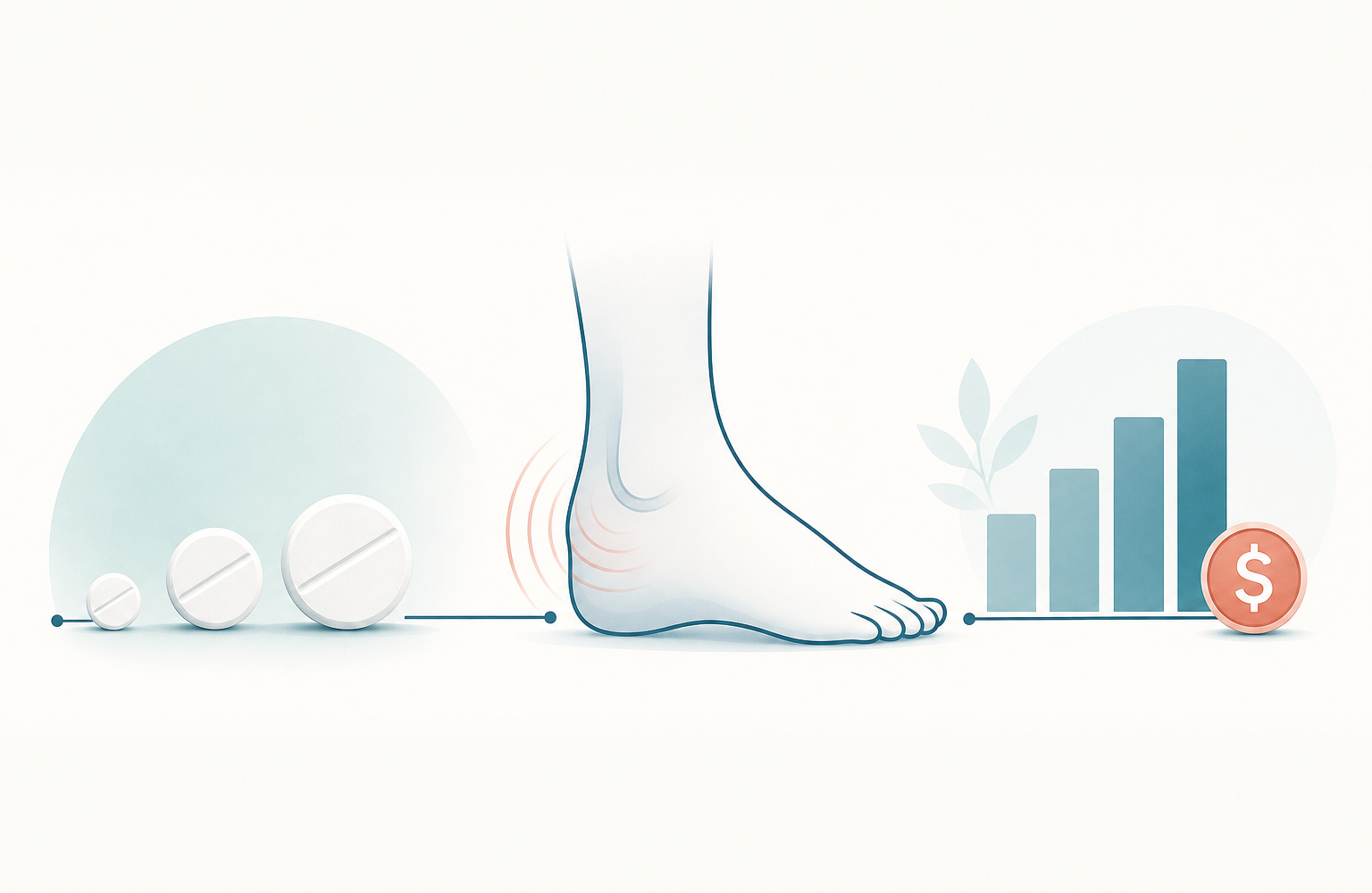
Three weeks into a 10 mg prescription, your socks leave a dent above the ankle. Shoes you've owned for years feel tight by dinnertime. Nothing hurts, exactly — it's just that your legs no longer look like your legs.
That's the single most common reason people search for amlodipine side effects, and there's a number attached to it that almost nobody gets told: at 10 mg, swelling showed up in 10.8% of patients in the FDA trials. At 5 mg, 3.0%. Same drug, roughly a third of the risk. The dose matters more than almost anything else about this medication, and that's the thread running through everything below.
At a glance
- Amlodipine's main side effect is ankle and leg swelling, and it's strongly dose-related: 1.8% at 2.5 mg, 3.0% at 5 mg, 10.8% at 10 mg, versus 0.6% on placebo.
- Women report swelling at nearly three times the rate men do — 14.6% versus 5.6% in the same trials.
- Only about 1.5% of patients in placebo-controlled trials stopped amlodipine because of side effects, barely above the 1% who stopped placebo.
- Generic amlodipine is one of the cheapest prescriptions in America — roughly $4 to $17 for a month at flat-price pharmacies, though an undiscounted drugstore counter can charge $30 to $60 for the identical tablet.
- Grapefruit is largely a non-issue with amlodipine specifically, but simvastatin is: the label caps it at 20 mg a day if you're taking both.
What amlodipine is and what it does
Amlodipine is a dihydropyridine calcium channel blocker, first approved in the US in 1987 under the brand name Norvasc. Generics have been around since 2007, and today it's among the three or four most-prescribed medications in the country.
Muscle cells in your artery walls need calcium to contract. Amlodipine blocks the channels that calcium moves through, so those arteries relax and widen. Peripheral resistance drops. Blood pressure follows.
It's a slow, steady drug by design. Across 15 placebo-controlled trials, once-daily amlodipine lowered standing blood pressure by about 12/6 mmHg and supine pressure by about 13/7 mmHg in mild to moderate hypertension — and held that effect through the full 24 hours between doses. Patients followed for a year didn't develop tolerance.
FDA-approved uses
- Hypertension, alone or with other blood pressure medications
- Chronic stable angina — the predictable chest pain that comes on with exertion
- Vasospastic angina, also called Prinzmetal's or variant angina, where coronary arteries spasm
- Angiographically documented coronary artery disease in patients without heart failure or an ejection fraction below 40%, to reduce hospitalizations for angina and the need for revascularization
That last one came out of CAMELOT, which randomized 1,318 patients with documented CAD. Over an average of 19 months, 16.6% of the amlodipine group hit a major cardiovascular endpoint versus 23.1% on placebo — a 31% relative reduction, driven mostly by 42% fewer hospitalizations for angina and 27% fewer revascularization procedures.
One thing amlodipine is not: a heart failure drug. The PRAISE-2 trial followed 1,654 patients with Class III or IV heart failure for a mean of 33 months and found no mortality benefit, with more reports of pulmonary edema in the amlodipine arm.
Amlodipine side effects, by the numbers
Amlodipine has been studied for safety in more than 11,000 patients. Most tolerate it well, and the discontinuation figure is the stat worth holding onto: in trials directly comparing amlodipine (n=1,730) against placebo (n=1,250), about 1.5% of patients quit over side effects, against about 1% on placebo.
The dose-response table
Four side effects track clearly with dose. These are the FDA label's own numbers:
| Side effect | 2.5 mg | 5 mg | 10 mg | Placebo |
|---|---|---|---|---|
| Edema (swelling) | 1.8% | 3.0% | 10.8% | 0.6% |
| Dizziness | 1.1% | 3.4% | 3.4% | 1.5% |
| Flushing | 0.7% | 1.4% | 2.6% | 0.0% |
| Palpitations | 0.7% | 1.4% | 4.5% | 0.6% |
Read the edema row again. Going from 5 mg to 10 mg roughly triples the swelling risk, and going down from 10 mg to 5 mg cuts it to under a third. This is why the standard move when someone's ankles blow up on 10 mg is often to halve the dose and add a second drug from a different class, rather than push through.
Side effects that don't track with dose
| Side effect | Amlodipine | Placebo |
|---|---|---|
| Fatigue | 4.5% | 2.8% |
| Nausea | 2.9% | 1.9% |
| Abdominal pain | 1.6% | 0.3% |
| Somnolence (sleepiness) | 1.4% | 0.6% |
Lowering the dose won't reliably help with these. Taking the tablet at bedtime sometimes does, if daytime tiredness is the problem.
Why women report more side effects than men
This is real, it's in the label, and no one seems to mention it. Among the same trial population, broken out by sex:
| Side effect | Men (n=1,218) | Women (n=512) |
|---|---|---|
| Edema | 5.6% | 14.6% |
| Flushing | 1.5% | 4.5% |
| Palpitations | 1.4% | 3.3% |
Nearly one in seven women on amlodipine reported swelling, against roughly one in eighteen men. Placebo rates were also higher in women (5.1% versus 1.4%), so some of the gap isn't the drug — but the drug-attributable difference is still substantial.
If you're a woman who started at 10 mg and your ankles swelled, you weren't unlucky and you aren't imagining it. You were in the highest-risk group the trials identified, at the highest approved dose.
Worth asking about: Before you abandon amlodipine over swollen ankles, ask whether 5 mg plus a low dose of a second medication would work for you. Combination therapy at modest doses is what most hypertension guidelines favor anyway, and the edema arithmetic above is a good argument for it.
Amlodipine and swollen ankles: what's actually happening
The mechanism explains why the usual fixes don't work.
Amlodipine dilates the small arteries feeding your capillaries but does little to the veins draining them. More pressure arrives, the same amount leaves, and pressure inside the capillary bed rises. Fluid gets pushed into the surrounding tissue. Gravity decides where it lands, which is why it's ankles and shins rather than your face.
The critical point: this is not fluid overload. You don't have extra fluid in your body, it's just in the wrong compartment. That's why a diuretic — the instinctive answer to swelling — usually disappoints here, and why your doctor may not reach for one.
What tends to help:
- A lower dose. See the table above.
- Adding an ACE inhibitor or an ARB. Drugs like lisinopril or losartan dilate veins as well as arteries, which relieves the capillary pressure causing the leak. This is a well-documented effect and often more useful than a diuretic.
- Switching within the class. Diltiazem is a calcium channel blocker with a different structure and a lower edema rate.
- Mechanical measures. Propping your legs up and wearing compression stockings genuinely help, if less dramatically than people hope.
And know when it isn't the drug. Swelling that comes on fast, affects only one leg, arrives with shortness of breath, or pairs with unexplained weight gain needs a same-day call — those point toward heart, kidney, liver, or a clot, not a calcium channel blocker.
Serious side effects and warnings
Rare, but these are the ones to recognize.
Worsening angina or heart attack after starting or increasing the dose. This is the label's most counterintuitive warning. Patients with severe obstructive coronary artery disease can develop worse chest pain or an acute MI shortly after beginning amlodipine or stepping the dose up. New or escalating chest pain in the days after a change is an emergency room situation, not a wait-and-see.
Symptomatic low blood pressure, particularly in people with severe aortic stenosis. Because amlodipine works gradually, sudden collapse is unlikely — but fainting or near-fainting deserves a prompt call.
Liver effects. Post-marketing reports include jaundice and elevated liver enzymes, occasionally severe enough to require hospitalization. If you have severe hepatic impairment, amlodipine's half-life stretches to about 56 hours and the dose should be titrated slowly. Yellowing of the eyes or skin, dark urine, or persistent right-upper-abdomen pain warrants a call.
Reported in fewer than 1% but more than 0.1% of patients: arrhythmias including ventricular tachycardia and atrial fibrillation, bradycardia, syncope, peripheral neuropathy, tremor, gingival overgrowth, sexual dysfunction, weight gain, muscle cramps, increased urinary frequency, angioedema and erythema multiforme. Gynecomastia appears in post-marketing reports.
Call 911 for swelling of the face, lips, tongue, or throat; trouble breathing; chest pain; or fainting.
Amlodipine dosage: 2.5 mg, 5 mg, and 10 mg
Amlodipine comes in three strengths, and which one you're on is the most consequential detail of your prescription.
| Situation | Dose | Notes |
|---|---|---|
| Typical adult, hypertension | Start 5 mg once daily | Maximum approved is 10 mg once daily |
| Small, frail, or elderly patients | Start 2.5 mg once daily | Clearance falls with age; exposure runs 40–60% higher |
| Hepatic insufficiency | Start 2.5 mg once daily | Titrate slowly in severe impairment |
| Adding amlodipine to existing BP drugs | 2.5 mg once daily | The label specifically endorses this lower entry point |
| Chronic stable or vasospastic angina | 5–10 mg once daily | Most patients need 10 mg for adequate effect |
| Documented coronary artery disease | 5–10 mg once daily | Majority required 10 mg in the trials |
| Children 6–17 | 2.5–5 mg once daily | Doses above 5 mg have not been studied; effect under age 6 is unknown |
| Reduced kidney function | Usual starting dose | Amlodipine's pharmacokinetics aren't meaningfully affected by renal impairment |
Titration steps should generally be 7 to 14 days apart. If your prescriber moved you from 5 mg to 10 mg, that's routine escalation — but it's also the step where swelling becomes three times more likely, so it's a fair moment to ask whether a second drug at a low dose is the better trade.
Is amlodipine 10 mg a high dose?
It's the maximum approved dose for blood pressure. Not dangerous, not unusual, and the dose most angina patients actually need — but it's the ceiling, and it's where the side-effect curve turns steep.
How long amlodipine takes to work, and how long side effects last
The pharmacokinetics answer most of the timing questions people have.
Amlodipine peaks in the blood 6 to 12 hours after a dose, which is unusually slow and part of why it doesn't cause the sudden flushing older calcium channel blockers did. Food makes no difference to absorption. The terminal half-life runs 30 to 50 hours, and blood levels don't reach steady state until 7 to 8 days of consecutive daily dosing.
Two practical consequences.
First, judging the drug after three days tells you nothing — you aren't yet taking a full effective dose in any real sense. Give it one to two weeks for the blood pressure effect.
Second, and less welcome: side effects that appear in week two or three are not "your body adjusting." They're the drug reaching full concentration. Edema in particular tends to build rather than fade, so waiting it out for months is usually not the right plan. Raise it at four to six weeks if it's bothering you.
Missed a dose? Take it when you remember — unless more than 12 hours have passed since the missed dose, in which case skip it and resume your normal schedule. Never double up.
What to avoid on amlodipine, and what you don't have to
The internet's list of things to avoid on this drug is longer than the label's.
Grapefruit: mostly a myth here
Grapefruit is the warning people hear most, and for amlodipine specifically the evidence is weak. The FDA label reports that 240 mL of grapefruit juice taken with a single 10 mg dose in 20 healthy volunteers had no significant effect on amlodipine's pharmacokinetics.
Grapefruit matters a great deal for some other calcium channel blockers — felodipine and nifedipine among them — and that reputation got transferred wholesale onto amlodipine. Some product labeling still advises caution, so mention your habits to your pharmacist. But if you've avoided breakfast grapefruit for years on amlodipine alone, the data behind that is thin.
Simvastatin: this one is real
Taking amlodipine 10 mg with simvastatin 80 mg raises simvastatin exposure by 77%. More statin in the blood means more risk of muscle injury, so the label is explicit: limit simvastatin to 20 mg daily if you're on amlodipine.
Atorvastatin carries no such cap — amlodipine 10 mg with atorvastatin 80 mg produced no significant change in atorvastatin levels. If you're on amlodipine and your cholesterol isn't controlled at simvastatin 20 mg, that's a concrete reason to discuss a switch. Our atorvastatin cost breakdown covers what the alternative runs.
Other interactions worth knowing
- Diltiazem 180 mg daily raised amlodipine exposure by 60% in elderly hypertensive patients. Watch for more dizziness and swelling.
- Strong CYP3A4 inhibitors — ketoconazole, itraconazole, ritonavir — can push amlodipine levels higher. Monitoring, not avoidance.
- Cyclosporine trough levels rose about 40% in kidney transplant patients on amlodipine.
- Sildenafil doesn't change amlodipine's pharmacokinetics, but both lower blood pressure independently, and the effects add up.
- NSAIDs like ibuprofen and naproxen blunt most blood pressure medications. Occasional use is fine; daily use deserves a conversation.
- No meaningful interaction with digoxin, warfarin, cimetidine, or antacids.
Does amlodipine cause a dry cough?
No, and this confusion costs people good medications. The nagging dry cough that drives roughly one in ten patients off their blood pressure pill is an ACE inhibitor effect — lisinopril, enalapril, ramipril. Amlodipine works through a different mechanism entirely and doesn't do it.
If you developed a cough after starting a blood pressure drug, check which drug. If amlodipine is the only one, look elsewhere for the cause.
Alcohol
Amlodipine had no significant effect on alcohol's pharmacokinetics in single and multiple 10 mg doses, so there's no direct interaction. The caution is simpler: alcohol lowers blood pressure on its own and makes dizziness worse. Moderate, and stand up slowly.
Amlodipine cost in 2026
Here's where the honesty has to come in, because the usual savings pitch doesn't apply to this drug.
Amlodipine is one of the cheapest prescriptions in the United States. It sits on the flat-price generic lists at Walmart, Kroger, and many independents — the $4-a-month, $10-for-90-days tier. Nothing beats that.
What varies wildly is what you pay if you don't ask.
| Where you fill it | Typical cost, amlodipine 10 mg | Notes |
|---|---|---|
| Flat-price generic list (Walmart, Kroger, independents) | ~$4 per 30 days, ~$10 per 90 days | The floor |
| Walmart retail, no program applied | ~$17 per 30 tablets | Still cheap |
| Costco cash price | ~$33 per 30 tablets | Membership not required at the pharmacy counter |
| Chain drugstore with a discount card | ~$6–$15 per 30 days | Varies by ZIP code |
| Chain drugstore, nothing applied | ~$30–$60 per 30 tablets | The avoidable price |
| Generic amlodipine via CanAmerica Plus | $74.99 per 100-tablet pack | Check the pricing calculator for your strength |
| Brand Norvasc, US retail cash | ~$330–$450 per 30 tablets | No clinical advantage over generic |
Prices reflect US cash-pay conditions as of October 2026 and shift month to month. Verify before you buy.
Being straight about where a cash-pay network helps
For generic amlodipine on its own, a cash-pay health network is usually not your cheapest route. A $4 flat-price fill at a big-box counter is hard to beat, and we'd rather say so than waste your time.
Where cash-pay options genuinely change the math:
- Brand-name Norvasc. If your prescription says brand and won't substitute, US retail cash pricing is punishing. Check the Norvasc listing against what your pharmacy quotes.
- Combination tablets. Caduet — amlodipine plus atorvastatin — runs $214.99 per 90-tablet pack through CanAmerica Plus, against brand US retail that lands far higher. The generic amlodipine/atorvastatin is also listed.
- The rest of your regimen. Almost nobody on amlodipine takes only amlodipine. If you're also filling a statin, metoprolol, hydrochlorothiazide, or an anticoagulant, the per-order economics change once shipping spreads across several medications. Our Eliquis pricing guide shows where those gaps get large.
- No flat-price pharmacy within reach. A $4 generic list only helps if you can get to the counter.
Savings tip: If you have insurance, compare your copay against the local cash price before handing over your card. Amlodipine is cheap enough that a $10 or $15 tier-one copay can cost more than simply paying cash. Pharmacists are allowed to tell you which is lower — in most states they only have to if you ask. Our Walmart $4 prescription list guide covers what else qualifies.
Combination pills: convenience versus cost
Amlodipine shows up inside a lot of combination tablets — paired with atorvastatin, valsartan, olmesartan, benazepril and others. One pill instead of two helps adherence, and the amlodipine-plus-ARB versions carry the edema advantage described earlier.
The catch is pricing. Single-ingredient generic amlodipine is almost free; combination products frequently aren't. If a combination costs meaningfully more than two separate generics, ask whether the convenience is worth it. Sometimes it clearly is. Sometimes nobody ever ran the comparison.
Amlodipine versus the alternatives
All of these lower blood pressure. They differ in how they make you feel and what they cost.
| Drug | Class | Dry cough? | Ankle swelling? | Generic cash price |
|---|---|---|---|---|
| Amlodipine (Norvasc) | Calcium channel blocker | No | Common, dose-related | $4–$17/month |
| Lisinopril (Prinivil) | ACE inhibitor | Yes, ~10% | Uncommon | $4–$15/month |
| Losartan (Cozaar) | ARB | Rare | Uncommon | $4–$15/month |
| Hydrochlorothiazide | Thiazide diuretic | No | No | $4–$15/month |
| Diltiazem | Calcium channel blocker | No | Less than amlodipine | $10–$30/month |
| Metoprolol | Beta blocker | No | Possible with heart failure | $4–$20/month |
None of these is the obvious winner, and the choice depends on your other conditions — kidney disease and diabetes favor an ACE inhibitor or ARB, gout argues against a thiazide, asthma complicates beta blockers. Our guides to losartan 50 mg and rosuvastatin 10 mg go deeper on two of the common companions.
Don't switch on your own. Untreated hypertension does far more damage than swollen ankles.
The bottom line
Amlodipine is an effective, cheap, well-tolerated blood pressure medication whose main drawback is a swelling problem that tracks closely with dose and hits women harder than men. If your ankles are the issue, the dose is the first conversation to have — and adding a low dose of an ACE inhibitor or ARB often works better than adding a diuretic.
On cost: this is a drug where a five-minute phone call can cut your bill by 80%. Check the flat-price generic list at a big-box pharmacy, check your copay against the cash price, and check whether a brand or combination prescription you're filling actually needs to be either. If you're managing several prescriptions at once, compare CanAmerica Plus pricing against what you pay today — then talk to your prescriber before changing anything clinical.
Frequently asked questions
What are five things to avoid when taking amlodipine?
Simvastatin above 20 mg daily is the firm one. Beyond that: don't double up after a missed dose more than 12 hours old, go easy on alcohol because it compounds the dizziness, use daily NSAIDs only with your prescriber's knowledge, and don't stop the drug abruptly on your own. Grapefruit, despite its reputation, showed no significant effect on amlodipine in the FDA label's own study.
What organ is amlodipine hard on?
For most people, none. Amlodipine caused no clinically significant changes in potassium, blood sugar, cholesterol, triglycerides, uric acid, BUN, or creatinine in trials, and kidney impairment doesn't change the starting dose. The liver is the organ to watch: amlodipine is about 90% metabolized there, and rare post-marketing reports describe jaundice and enzyme elevations. Severe liver impairment calls for slower titration.
Can I drink alcohol with amlodipine?
There's no direct chemical interaction — amlodipine didn't alter alcohol's pharmacokinetics in studies. The practical problem is additive: alcohol lowers blood pressure and worsens the lightheadedness amlodipine can already cause. Moderate amounts, and stand up slowly.
Does amlodipine cause weight gain?
Weight gain appears in the label among effects reported in under 1% of patients, so it's possible but uncommon. More often, what feels like weight gain is fluid in the legs from the edema described above — the scale moves a few pounds, the waistband doesn't. Rapid weight gain with shortness of breath is a different matter and needs a prompt call.
Does amlodipine cause more side effects in women?
Yes, measurably. In the FDA trials, edema affected 14.6% of women versus 5.6% of men, flushing 4.5% versus 1.5%, and palpitations 3.3% versus 1.4%. Placebo rates were also somewhat higher among women, so not all of the gap is the drug — but the difference is real enough to factor into dosing discussions.
What are the contraindications for amlodipine?
The only absolute contraindication is known sensitivity to amlodipine. Caution applies with severe aortic stenosis, severe obstructive coronary artery disease, and severe hepatic impairment, and it should be used in pregnancy only if the potential benefit justifies the risk. The label recommends discontinuing nursing while taking it.
Why does my amlodipine look different this month?
Pharmacies rotate generic manufacturers based on supply and contracts. The active ingredient and strength are identical; fillers, coating and imprint differ. If the imprint doesn't match what you expect, ask your pharmacist to confirm before taking it.
This article is for informational purposes only and does not constitute medical advice. Always consult with a qualified healthcare provider for diagnosis and treatment. Pricing information is current as of the publication date but may change. Verify pricing directly before making purchasing decisions.